
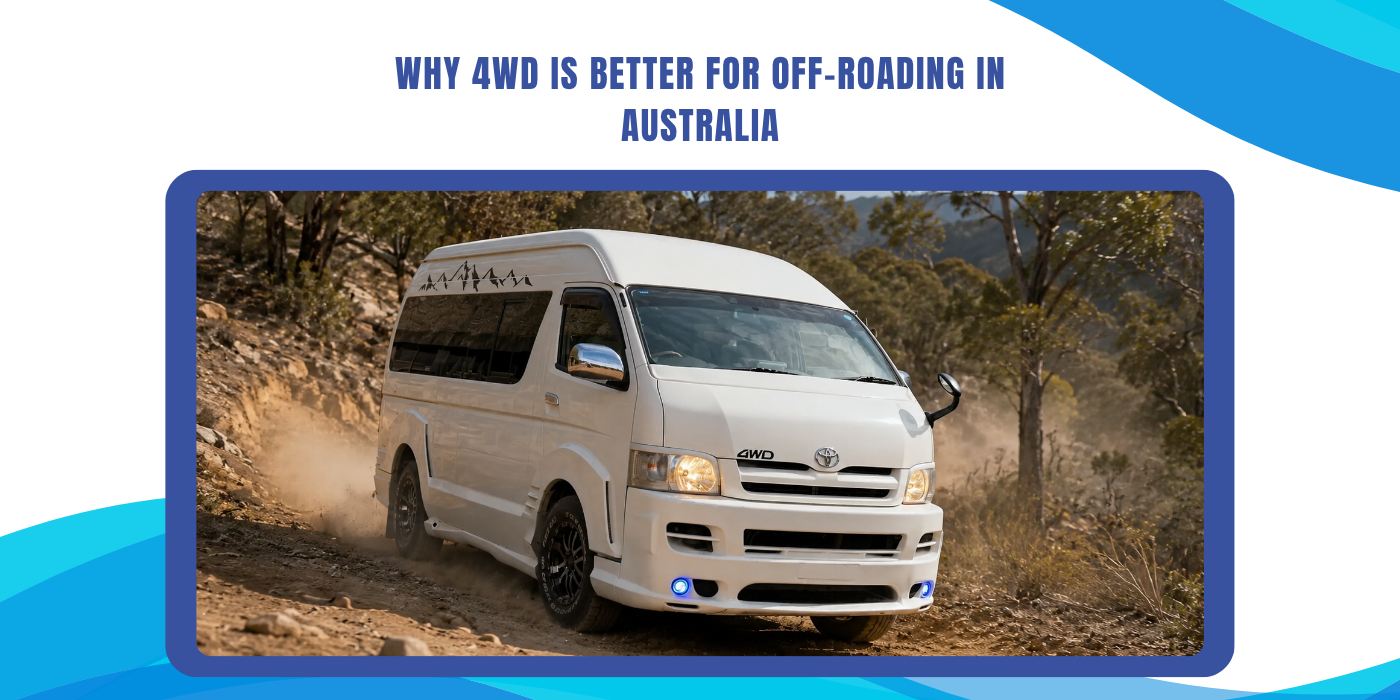
If you've ever wondered why 4WD is better for off-roading in Australia, the answer becomes obvious the moment the bitumen runs out. A corrugated dirt track stretches ahead into red dust or thick scrub, and suddenly your vehicle's ability to grip loose ground is the only thing that matters. Get it right and a capable four-wheel drive unlocks some of the most beautiful, remote country on earth. Get it wrong in a two-wheel-drive car and you're digging your wheels out of soft sand with a shovel and a lot of regret.
This is exactly where four-wheel drive earns its reputation. Not as a badge or a marketing line, but as a genuine mechanical advantage: real traction, better ground clearance and low-range gearing that keep you moving when a 2WD vehicle would be bogged. Australian off-road terrain, from sandy beach runs and desert crossings to muddy tracks and rocky climbs, demands exactly this kind of capability.
In this off-road buying guide we'll break down why 4WD beats 2WD on Australian tracks, the key things to look for when buying a 4WD vehicle, and how a 4WD van like the Toyota HiAce has quietly become one of the smartest off-road vehicles and campervan bases for adventurers who refuse to compromise on space or comfort. Whether you're planning your first outback trip or upgrading to a proper touring rig, understanding four-wheel drive is the first step toward exploring Australia with confidence.
Key Takeaways
- Four-wheel drive sends power to all four wheels, giving you real traction on sand, mud and loose gravel where two-wheel drive struggles.
- Australian off-road tracks (corrugations, deep sand, river crossings, rocky climbs) demand durability, ground clearance and low-range gearing, not just engine power.
- Understanding a few basics like diff locks, low range, approach angles and tyre pressures matters far more off-road than raw horsepower.
- A 4WD Toyota HiAce gives you genuine off-road capability plus a spacious, liveable interior, which is why HiAce 4WD vans and campervans have become so popular.
- Buying a quality, well-inspected Japanese import from a dealer who prices honestly protects your budget, your safety and your resale value.
What Makes Australian Off-Road Terrain So Demanding
If you plan to travel beyond the sealed roads, it helps to understand what you're actually up against. Australia is enormous, sparsely populated and unforgiving once you leave town. The sheer distances mean a breakdown or a bogging isn't just inconvenient. Out on a remote outback track, it can be genuinely dangerous.
Corrugations, Deep Sand and River Crossings
The classic Aussie four-wheel-drive track is corrugated: those endless washboard ripples that hum through the whole vehicle and shake loose anything not bolted down properly. On top of that you'll hit deep, soft sand on beach runs and desert crossings, sticky black mud after rain, water crossings that test your wading depth, and rocky creek beds that scrape at anything with low clearance.
None of these are edge cases. Head to K'gari (Fraser Island), the Simpson Desert, the Victorian High Country, the Gibb River Road or Cape York and you'll meet all of them, often in a single trip. A vehicle built for the school run simply isn't engineered for that kind of sustained punishment, which is why traction, suspension travel and reliability matter so much on Australian terrain.
Why Two-Wheel Drive Vehicles Struggle Off the Blacktop
A standard 2WD vehicle struggles off-road for two main reasons: ground clearance and traction. Most passenger cars sit too low, so the undercarriage, exhaust and fuel tank catch on ruts, rocks and crests. And because they only drive two wheels, the moment those wheels lose grip in sand, mud or on a loose climb, the car simply spins and stops.
Here's how 4WD vs 2WD compares where it counts:
- Ground clearance: a 2WD sits low and is easily damaged, while a 4WD rides higher and clears obstacles safely.
- Traction: a 2WD only drives two wheels, whereas a 4WD sends power to all four.
- Terrain suitability: a 2WD is limited to sealed roads, but a 4WD is genuinely all-terrain capable.
- Recovery risk: a 2WD bogs easily in soft ground, while a 4WD stays out of trouble with the right gear.
- Wading and climbing: a 2WD is limited here, but a 4WD is strong thanks to low-range gearing.
The point isn't that two-wheel drive is useless. It's fine for the highway commute. It's that it was never designed for the remote country most Australians actually want to explore.
How 4WD Actually Works: Traction, Torque and Low Range
People often ask why four-wheel drive is so much better off-road, expecting a complicated answer. The core idea is simple. Instead of driving just the front or rear wheels, a 4WD system splits engine power across all four wheels. That single change transforms how a vehicle handles loose and uneven surfaces, and it's the foundation of proper off-road traction.
Power to All Four Wheels
When all four wheels are driven, losing grip on one doesn't stop the vehicle. If a front wheel lifts over a rock or a rear wheel drops into soft sand, the others keep pulling. That built-in redundancy is what maintains momentum up a loose climb or across a soft patch that would leave a two-wheel-drive car spinning helplessly.
It also makes the vehicle feel planted. Because power is shared across the chassis through the transfer case rather than concentrated on one axle, the whole vehicle sits more stable and predictable on shifting surfaces. This distributed traction is the single biggest safety benefit of four-wheel drive off-road.
Low Range Gearing and Torque Control
The other half of the magic is low range. This is a second set of gearing in the transfer case (the "low box") that multiplies torque and slows everything right down for crawling over obstacles or descending steep, loose slopes under full control. Low-range gearing is a genuine 4WD feature that soft-roader all-wheel-drive systems usually lack, and it's a big part of what separates a real off-roader from a car that just looks rugged.
Good torque management means power reaches the ground without lighting up the tyres in a cloud of wheelspin. Less wheelspin means better traction, less tyre wear, less driveline strain and far less chance of digging yourself into a hole. Add a differential lock (which forces both wheels on an axle to turn together) and you can drive through situations that stop most vehicles cold.
Worth knowing: Not all "4WD" is equal. Part-time 4WD (two-wheel drive on-road, engage four-wheel drive when needed), full-time or constant 4WD, and all-wheel drive (AWD) all behave differently. If serious off-roading is the goal, look for a proper 4WD system with low range and ideally a rear diff lock. We break the differences down in our 4WD vs RWD HiAce campervan guide.
Stability and Safety on Loose and Unsealed Surfaces
Capability is one thing, but the real reason 4WD matters is safety. When you're a long way from help, your vehicle's ability to stay controlled on unpredictable ground isn't a luxury. It's what keeps a good trip from turning into a bad one.
Keeping Control on Loose Gravel and Sand
Loose gravel is deceptively dangerous. A 2WD vehicle can slide, lose steering feel and understeer straight off a bend before you've had time to react. Because a 4WD drives all four wheels, grip is spread across the vehicle and it tracks far more predictably. You feel connected to the road even when the surface is trying to shrug you off.
The same applies in sand. Where a two-wheel-drive bogs the instant it hits a soft patch, a 4WD holds momentum by pulling with every wheel at once, which is exactly what you want on a beach run or a dune crossing.
How 4WD Helps You Avoid Getting Bogged
Getting bogged is the fear that keeps a lot of people on the tar, and fair enough, because it's miserable and sometimes risky. But it's largely avoidable. Most boggings come from wheelspin, where the wheels dig in rather than drive forward. A 4WD system managing torque across all four wheels is far less likely to spin uselessly, and combined with a few good habits (steady momentum, correct tyre pressure, the right gear selection) it will get through sections that strand a normal vehicle.
Here's how each surface plays out:
- Loose gravel: a 2WD is prone to sliding, while a 4WD stays stable and controlled.
- Deep sand: a 2WD faces a high bogging risk, but a 4WD holds its momentum.
- Muddy tracks: a 2WD loses traction, whereas a 4WD keeps consistent grip.
- Corrugated roads: a 2WD rattles and handles poorly, while a 4WD stays composed.
- Steep loose climbs: a 2WD stalls and slips, but a 4WD crawls up in low range.
The 4WD Van: The Best of Both Worlds
For a long time, off-road capability meant a ute or a big, thirsty wagon. Great on the trail, less great as the vehicle you also have to live with Monday to Friday. That trade-off is exactly why 4WD vans and 4WD campervans have taken off with modern Australian travellers.
From City Commute to Remote Outback Track
The appeal is simple: one vehicle that handles the weekday city run and the weekend escape. A 4WD van slots into a suburban car park, cruises the highway comfortably, then confidently takes on gravel, sand and station tracks when the pavement ends. You don't need a daily car and a separate adventure rig, because a capable 4WD van is genuinely both.
Why the Toyota HiAce 4WD Van Stands Out
At Rising Rides, the Toyota HiAce 4WD is one of the vehicles we get most excited about, and for good reason. It pairs a genuine four-wheel-drive system with the HiAce's famously spacious, boxy, high-roof interior, which makes it a brilliant base for touring, camping or a full campervan conversion. You get the room to carry (and sleep alongside) all your gear, plus the drivetrain to actually reach the places worth carrying it to.
Toyota reliability is the other half of the story. These are engines and drivetrains built to rack up big kilometres with minimal drama, which matters enormously when you're hundreds of kilometres from the nearest mechanic. The HiAce also has a huge aftermarket for touring and camper fit-outs, so parts, storage systems and 12-volt setups are easy to source. If you're weighing up whether a HiAce import is the right move, our complete guide to what a Toyota HiAce 4x4 actually is walks through how the system works and whether it suits real-world use. If you're dreaming of a build, the HiAce camper conversion step-by-step guide is a natural next read.
You can also just browse our current HiAce 4WD stock to see what's landed recently.
What to Look For in an Off-Road Van or 4WD Campervan
If you're buying a 4WD with adventure in mind, a few things matter far more than the badge or the paint.
Build quality and durability. Corrugations and heavy touring loads test a chassis, suspension and mounts hard. Look for a solid, proven platform with a documented service history. This is the foundation everything else sits on.
Genuine ground clearance. Height keeps your undercarriage, fuel tank and driveline safe over rocks and ruts. Check it early on any potential buy, along with the tyre size and whether it can fit a larger all-terrain tyre later.
A drivetrain suited to the job. Confirm it's a genuine 4WD with low range, not an AWD dressed up to look tough. Ask about diff locks, wading depth and whether the transfer case shifts cleanly between high and low range.
Room to live and store. The whole point of a van is usable space. Think about how you'll sleep, cook, and store recovery gear, water and fuel before you fall for a particular layout.
Honest history and clean paperwork. With Japanese imports especially, the paperwork tells the real story. A proper inspection, a verified odometer and clean compliance are non-negotiable. More on that below.
Essential Off-Road Driving Tips for 4WD Owners
The vehicle gets you halfway. Driving technique does the rest. A few fundamentals will keep you out of trouble on any Australian track.
- Air down your tyres. Lowering tyre pressure in sand or mud spreads the contact patch so the tyre floats over the surface instead of digging in. Many drivers run around 18 psi in soft sand versus roughly 36 psi on the highway, but check your vehicle's guidance. Always carry a tyre pressure gauge and a portable air compressor to reinflate on hard roads.
- Know your clearance and angles. Understand your approach angle, departure angle and ramp-over angle so you don't bury the bumper or scrape the belly on a steep crest.
- Keep steady momentum. In sand especially, smooth and consistent momentum beats sudden bursts of throttle, which just spin the wheels and dig you in.
- Walk the tricky bits first. Scouting an obstacle, rut or water crossing on foot takes two minutes and can save a very expensive repair.
- Carry recovery gear. Traction boards, a long-handled shovel, a rated snatch strap, a compressor and a solid recovery point are cheap insurance. Just as importantly, learn how to use them safely before you need to.
The Practical Case for 4WD: Value, Reliability and Access
Beyond the fun, a good 4WD is a genuinely sensible buy, and the numbers back it up.
Strong resale value. Well-kept 4WDs, and Toyota 4WDs in particular, hold their value strongly in the Australian used-car market. Demand is consistently high, so a quality vehicle protects your investment far better than an average passenger car. If resale is front of mind, our campervan maintenance guide is worth a look for keeping yours in top condition.
Long-term reliability. The right platform is built to endure heat, dust, corrugation and heavy loads. That means fewer surprise repairs, more time on the road, and real peace of mind when you're a long way from town.
Access to the best of the country. This is the one that really counts. So many of Australia's most breathtaking destinations, from remote beaches and desert crossings to alpine tracks and hidden waterholes, simply aren't reachable in a 2WD. A capable four-wheel drive hands you the key to all of it.
To put it plainly:
- Terrain capability: a standard 2WD sticks to sealed roads, while a 4WD performs on all surfaces.
- Resale value: a 2WD tends to depreciate quickly, whereas a quality 4WD holds strong market demand.
- Off-road safety margin: a 2WD offers only basic control, while a 4WD gives you superior traction and stability.
- Travel range: a 2WD keeps you on the highways, but a 4WD unlocks remote outback access.
- Touring suitability: a 2WD is limited, while a 4WD is highly capable with the right fit-out.
4WD Van vs Ute vs Compact Motorhome: A Quick Comparison
There's no single best off-road vehicle. It depends on how you travel.
Traditional 4WD utes are the go for heavy towing and trade work. Rugged and capable, but living space is minimal unless you add a canopy or slide-on camper.
4WD vans are the versatile all-rounder: enclosed, secure and doubling as both transport and accommodation. Ideal for solo travellers and couples who want one vehicle to do everything, from the commute to the coast to the outback.
Compact 4WD motorhomes lean furthest toward comfort, with a fully fitted interior, while staying agile enough to reach places big motorhomes simply can't.
In short: a traditional ute is best for work and trades, with heavy-towing strength but minimal or external living space. A 4WD van is the versatile pick for solo and couple travel, offering integrated living space in one do-it-all package. And a compact motorhome is built for extended touring, with full or premium comfort while still reaching places larger rigs can't.
Not sure which suits you? Our guide to the best HiAce 4WD models reviewed breaks the options down by spec, price and trip style.
Buying a Japanese Import 4WD the Right Way
A lot of the best-value 4WD vans in Australia are Japanese imports. They're often well-maintained, well-specced and noticeably cheaper than the local equivalent. But imports come with their own homework: compliance plates, roadworthy certification, and knowing the vehicle's real history and odometer reading.
This is where buying from the right dealer matters. Our 4WD HiAce buyer's checklist covers exactly what to inspect, and a PPSR check will tell you whether a vehicle carries finance owing or has been written off, and clean compliance paperwork keeps your registration and insurance straightforward. Don't skip these steps. They're the difference between a genuine bargain and a very expensive mistake.
Why Buy Your 4WD From Rising Rides
We're a boutique dealership based in Lidcombe, Sydney, and we specialise in high-quality Japanese imports, with a real soft spot for the Toyota HiAce 4WD. Choosing a vehicle for the outback is a big decision, so we keep the whole process personal and straightforward instead of pushy.
Every vehicle we sell is thoroughly inspected before it reaches the showroom floor, and we price honestly, with no hidden extras, no surprises, and detailed specifications on every unit so you can decide with full confidence. We also make ownership easy from there, with flexible finance options, trade-ins, and Australia-wide delivery that brings your van straight to your door wherever you live. After the sale we're still here for maintenance advice and support down the track.
"The best way to predict the future of your travels is to invest in a vehicle built to last every mile of the journey."
If you've got a trip in mind, get in touch with our team. Tell us how you like to travel and we'll help you find the right 4WD match.
Conclusion
The right vehicle completely changes how you experience Australia. A capable 4WD gives you the freedom to explore remote tracks with confidence, the safety margin to do it sensibly, and the resale strength to make it a smart buy on top of everything else.
Whether it's a rugged ute or a versatile Toyota HiAce 4WD, your choice shapes every trip you take. And with a quality Japanese import matched to local conditions, properly inspected and honestly priced, you get all of that capability without paying over the odds.
Your next adventure starts with the right rig. Browse our current stock or have a chat with the team, and we'll see you out on the tracks.