
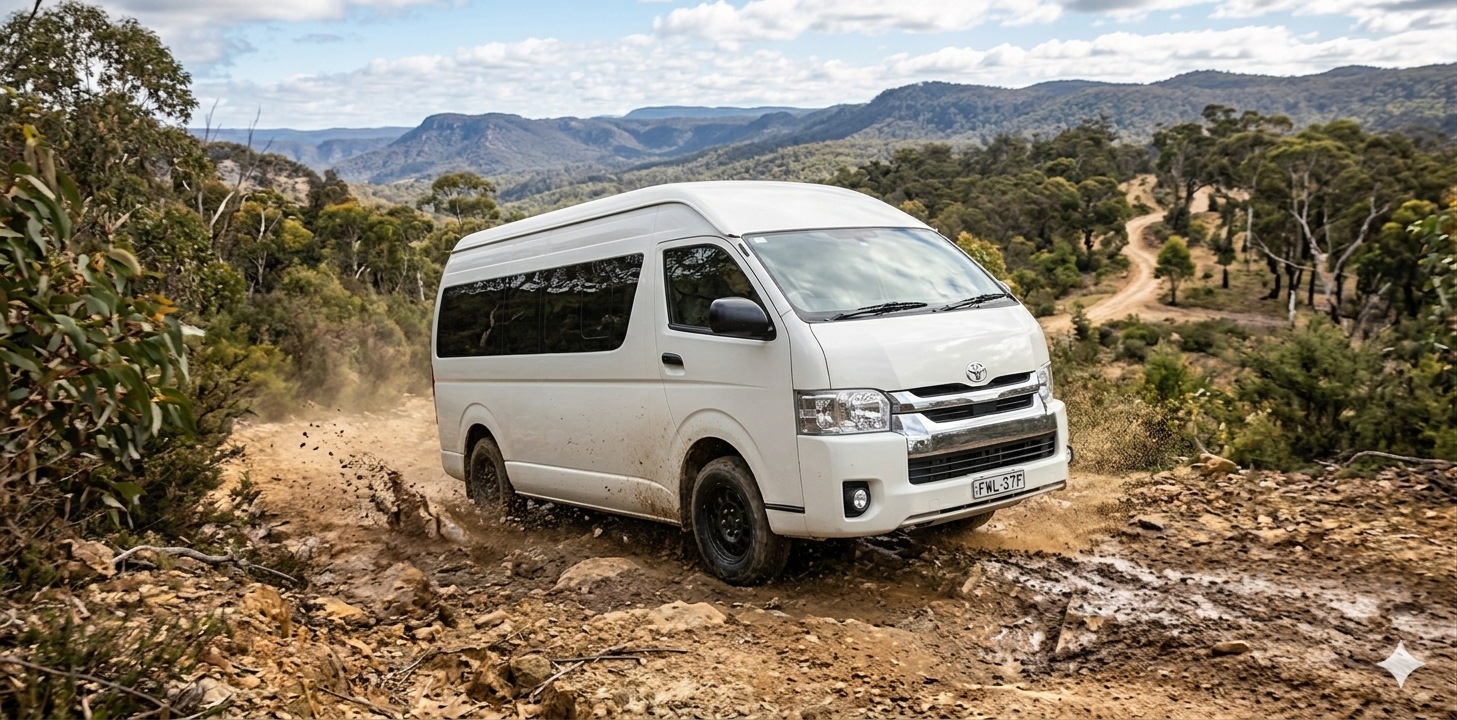
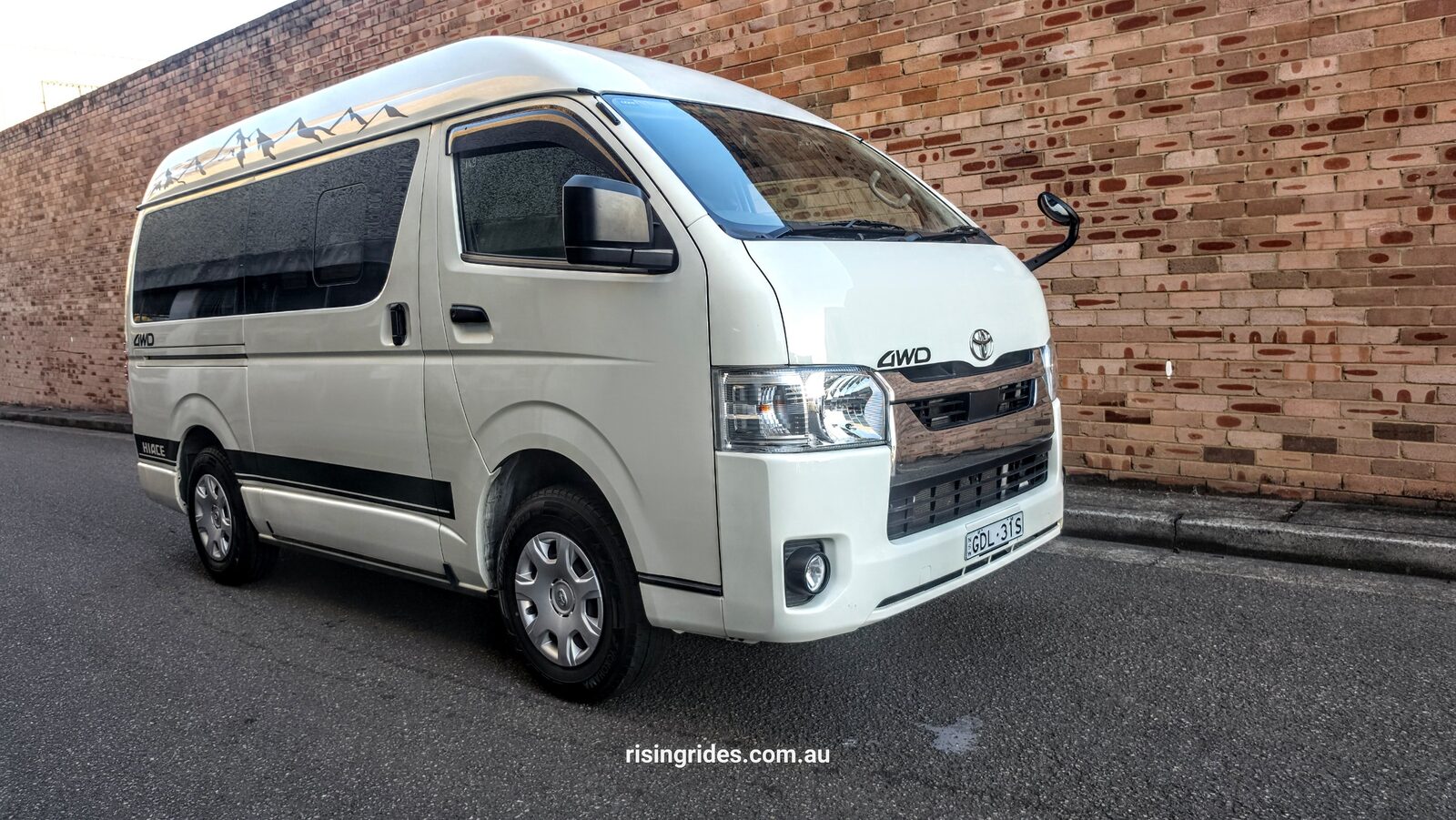
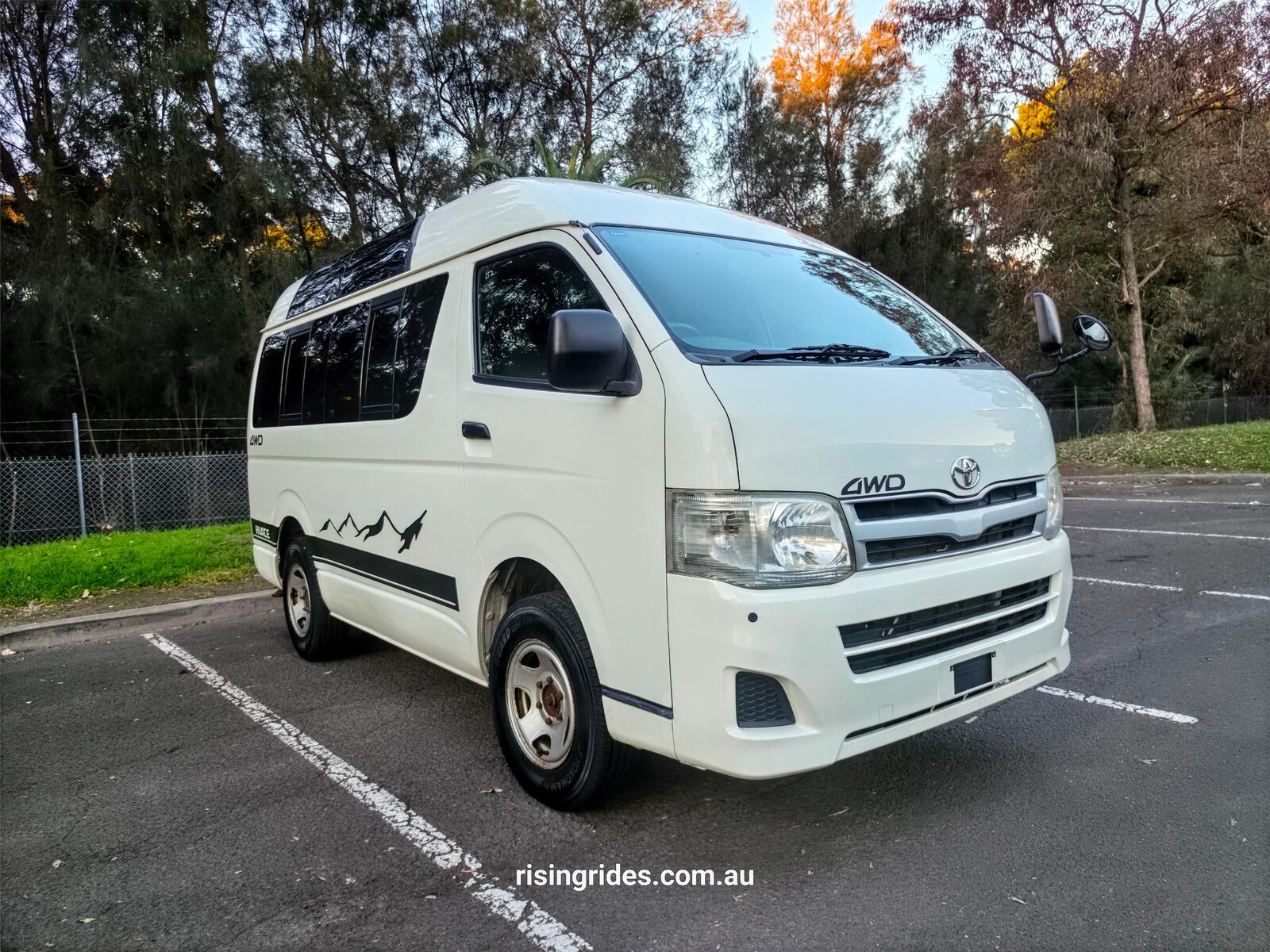
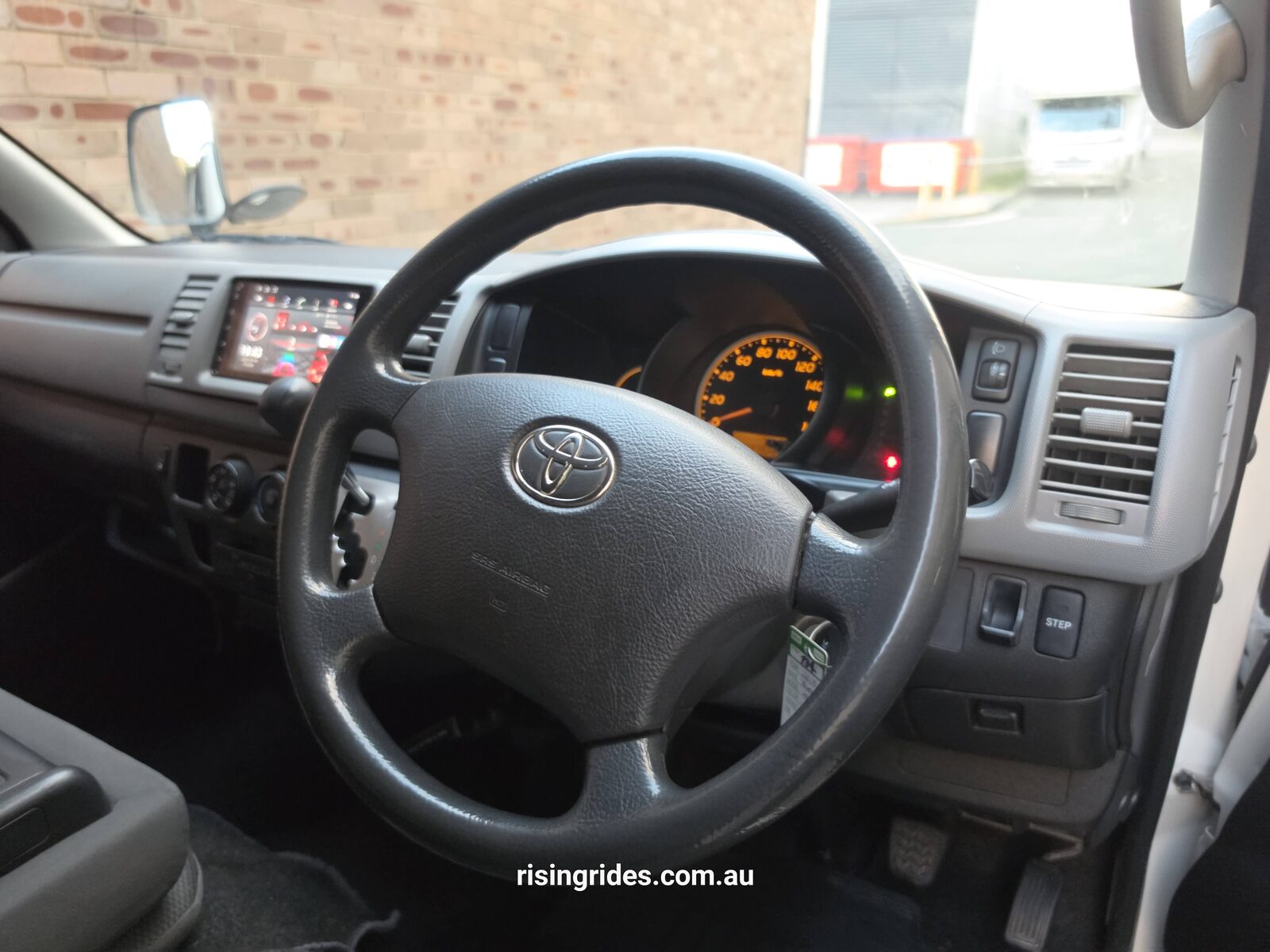
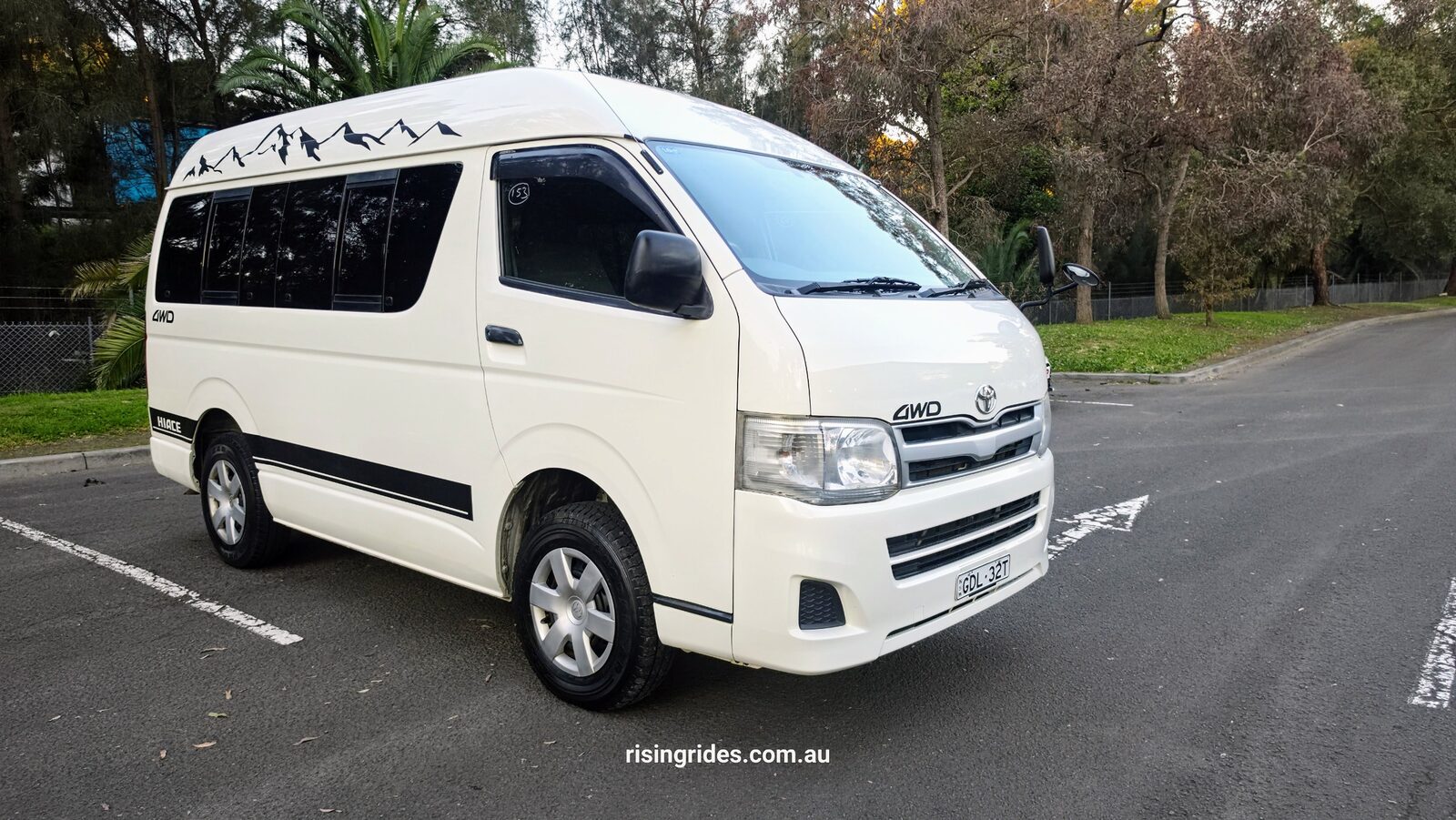
What Exactly Is a HiAce 4x4?
The term HiAce 4x4 refers to a Toyota HiAce van that has been fitted with a four-wheel-drive (4WD) system, delivering engine power to all four wheels rather than just the rear two of a standard HiAce.
In Australia, the phrase covers three different types of vehicles that are often lumped together but are meaningfully different:
- JDM factory 4WD (H100 series, pre-2005) — older HiAces built for Japan's domestic market with a proper part-time 4WD system including a transfer case and high/low range
- JDM factory AWD (H200 series, 2005–present) — newer HiAces using a full-time AWD system borrowed from the Toyota Kluger, with no low range or locking hubs
- Aftermarket 4x4 conversions — standard 2WD HiAces that have been converted to 4WD by specialist workshops such as Bus4x4 in Australia
Understanding which type you are looking at matters enormously — because they behave very differently on and off the road.
📌 Key point
Toyota never sold a factory 4x4 HiAce in Australia through its official dealer network. Every HiAce 4x4 in Australia is either a Japanese import or an aftermarket conversion. This is why they can be hard to find and why so much confusion exists around them.
A Brief History: When Did Toyota Make a 4x4 HiAce?
Toyota has been producing 4WD variants of the HiAce since the 1980s, though exclusively for the Japanese domestic market. Here is a simplified timeline:

The shift from H100 to H200 is significant. The H100 4WD is a traditional 4x4 in the way most Australians understand the term. The H200 AWD is a more modern, automated system — convenient but less capable in serious off-road situations. Many buyers expecting the older system are surprised when they look under an H200.
How the 4WD System Actually Works
To understand what a HiAce 4x4 can and cannot do, it helps to understand the basic mechanics. Here is how the system in each type of HiAce operates:
H100 Series: Part-Time 4WD with Transfer Case

In the H100, the driver manually selects 2WD (rear wheels only) or 4WD using a dashboard switch and floor-mounted lever. When 4WD is engaged, power is sent to both front and rear axles through a transfer case — a separate gearbox that also provides low range for slow, high-torque situations like steep hills or soft sand.
- 2H (2WD High) — normal road driving, rear wheels only
- 4H (4WD High) — loose gravel, wet grass, moderate off-road — engage above 5km/h
- 4L (4WD Low) — steep hills, deep sand, rock — engage at standstill in neutral
⚠️ Important
The transfer case in H100 HiAces is vacuum-actuated. If vacuum pipes are disconnected or cracked, 4WD may appear to engage (the dashboard light comes on) but the front axle receives no power. Always physically test 4WD engagement — drive in a tight circle in 4H and check for drivetrain binding.
H200 Series: Full-Time AWD (Kluger-Derived)

The H200's AWD system is fundamentally different. Power is distributed automatically to all four wheels at all times — there is no manual 4WD selection, no low range, and no freewheeling hubs. The system uses a centre differential (similar to a Kluger or RAV4) to vary how much torque goes to each axle depending on traction conditions.
This means you never have to think about engaging 4WD — but it also means the system cannot produce the low-speed, high-torque crawling ability of a traditional 4x4 with low range.
Old 4WD vs New AWD: The Important Difference
This is the question that comes up most often when buyers are comparing HiAce 4x4 options. Here is a direct comparison:

✅ Honest take
For most buyers — touring couples, vanlifers, rural property owners — the H200 AWD is the better choice because it is newer, better equipped and far easier to live with day-to-day. But if you genuinely need low range for steep or very soft terrain, the H100 is the more capable off-road vehicle. Know your use case before you buy.
Engines: 1KD vs 1GD Explained
HiAce 4x4 models come with several engine options. The two most relevant for Australian buyers are:
1KZ-TE (3.0L Turbo Diesel — H100 only)
Found in older H100 models. The 1KZ was the engine of its era — reasonably reliable but known for head gasket issues if overheated. By now, most good 1KZ engines have either had the issues sorted or have been replaced. Timing belt must be replaced every 150,000 km without exception.
1KD-FTV (3.0L Turbo Diesel — H100 and early H200)
Toyota's replacement for the 1KZ and one of the most proven diesel engines ever made. Simple, strong, and easy to service anywhere in Australia. Mechanics everywhere know this engine. It does have a timing belt that needs regular replacement. Found in both late H100 and early H200 models.
1GD-FTV (2.8L Turbo Diesel — later H200)
The modern replacement, paired with a 6-speed automatic. Uses a timing chain instead of a belt, which eliminates that maintenance concern. More power and better fuel efficiency than the 1KD. However, it uses a Diesel Particulate Filter (DPF) that can cause issues if the vehicle is used predominantly for short, slow drives without regular highway runs to regenerate the filter.

⚠️ DPF warning
The 1GD engine's DPF requires the van to be driven at highway speeds regularly to complete passive regeneration. If you will mostly be driving short distances at low speeds — around a farm, in the city, on slow off-road tracks — a 1KD or 1KZ without a DPF may be a more practical choice.
What JDM Means and Why It Matters
JDM stands for Japanese Domestic Market. It refers to vehicles manufactured and originally sold in Japan — not exported through Toyota's official channels to countries like Australia.
Japan has a vehicle inspection system called Shaken (車検), which requires expensive mandatory inspections every two years. Because of the cost, many Japanese owners sell their vehicles before they are due — often at low kilometres and in excellent condition. These vehicles are then exported to countries including Australia, where they are imported and complied to local standards.
Why JDM HiAces tend to be well-maintained
- Japan's Shaken system creates financial pressure to sell vehicles at 3–5 years old, regardless of condition
- Japanese road conditions (narrow, smooth roads, low speed limits) mean less mechanical stress than Australian country driving
- Dealer servicing culture in Japan means most vehicles have proper service records
- Japanese auction houses independently grade every vehicle before sale — this grade is documented and travels with the car
Understanding Japanese auction grades
Every vehicle sold through Japanese auction receives two sets of grades: an overall condition grade (1–5) and separate grades for exterior (A–E) and interior (A–E).
 📌 What to ask for
Always ask to see the original Japanese auction sheet when buying a JDM HiAce 4x4. A reputable seller will provide it without hesitation. If they cannot produce it or say it doesn't exist — treat that as a significant red flag.
Real Off-Road Capability: What the HiAce 4x4 Can and Cannot Do
The HiAce 4x4 has developed a bit of a mythological reputation in Australia — it is sometimes talked about as if it were a Troopcarrier substitute. The reality is more nuanced and depends heavily on which variant you own.
What the HiAce 4x4 handles well
- Corrugated gravel roads — the long wheelbase gives excellent high-speed stability on corrugations that upsets shorter vehicles
- Wet grass and muddy driveways — both 4WD and AWD prevent the wheelspin that a 2WD HiAce suffers in these conditions
- Sandy beach tracks — with correct tyre pressure, the AWD/4WD system manages sand reasonably well
- Snow and alpine roads — genuinely safer than a 2WD van in cold, slippery conditions
- Fire trails and formed dirt roads — comfortable territory for both H100 and H200 variants
Where the HiAce 4x4 struggles
- Ground clearance — factory clearance is limited compared to a lifted 4WD. Rock strikes on the underbody are a real risk on rough tracks
- Axle articulation — independent front suspension limits wheel travel in uneven terrain where a solid axle vehicle would keep all tyres on the ground
- Deep mud — the AWD system in particular will bog in serious mud without low range to crawl out slowly
- Reversing on hills — a well-documented HiAce weakness — front-heavy weight distribution means the rear wheels lose traction when reversing uphill
- Extreme rock terrain — neither variant is designed for serious rock work
✅ Honest assessment
The HiAce 4x4 is not a Troopcarrier. It is a practical, capable van for the kind of off-road driving that most Australians actually do — property access, campsite tracks, coastal roads and rough country highways. If your plans involve serious rock crawling or expedition-level terrain, you need a different vehicle.
4x4 Conversions: How They Work
For buyers who want more off-road capability than a JDM AWD HiAce provides, aftermarket 4x4 conversions are an option. The most well-known in Australia is the Bus4x4 conversion.
What a Bus4x4 conversion involves
- Drivetrain swap — a transfer case is mounted behind the original gearbox, splitting power to a new front prop shaft and retaining the rear shaft
- Front subframe replacement — a modified subframe accommodates the new front differential
- Suspension lift — typically 150–180mm of lift to create adequate ground clearance
- Low range — a proper dual-range transfer case enables low-range crawling that the factory AWD cannot provide
- Optional rear diff lock — adds further capability in loose terrain
- ADR compliance — Bus4x4's conversions are approved under Australian Design Rules and can be legally registered
⚠️ Conversion costs
A professional 4x4 conversion typically costs $15,000–$25,000 AUD on top of the base vehicle. Budget accordingly — and be cautious of cheap, unverified conversions. Poorly done drivetrain work creates serious safety issues.
Common Issues to Know About
No vehicle is perfect. Here are the issues that come up regularly with HiAce 4x4 models:
H100 (older 4WD)
- Vacuum system failures — the vacuum-actuated 4WD engagement system develops leaks with age, causing 4WD to appear engaged without actually working
- Freewheeling hub service — hubs need periodic cleaning and lubrication; stiff or seized hubs prevent 4WD from engaging properly
- Timing belt — must be replaced on schedule; a snapped belt causes catastrophic engine damage
- Rust on older examples — particularly floor pans, rear wheel arches and underbody sections
H200 (newer AWD)
- DPF blockage (1GD engines) — short, slow driving prevents the DPF from self-cleaning, leading to blocked filters requiring expensive regeneration
- AWD centre diff wear — less common but possible with high kilometres and infrequent fluid changes
- Fuel consumption — petrol AWD models (2TR engine) can return 14L/100km or more, which surprises buyers expecting diesel efficiency