
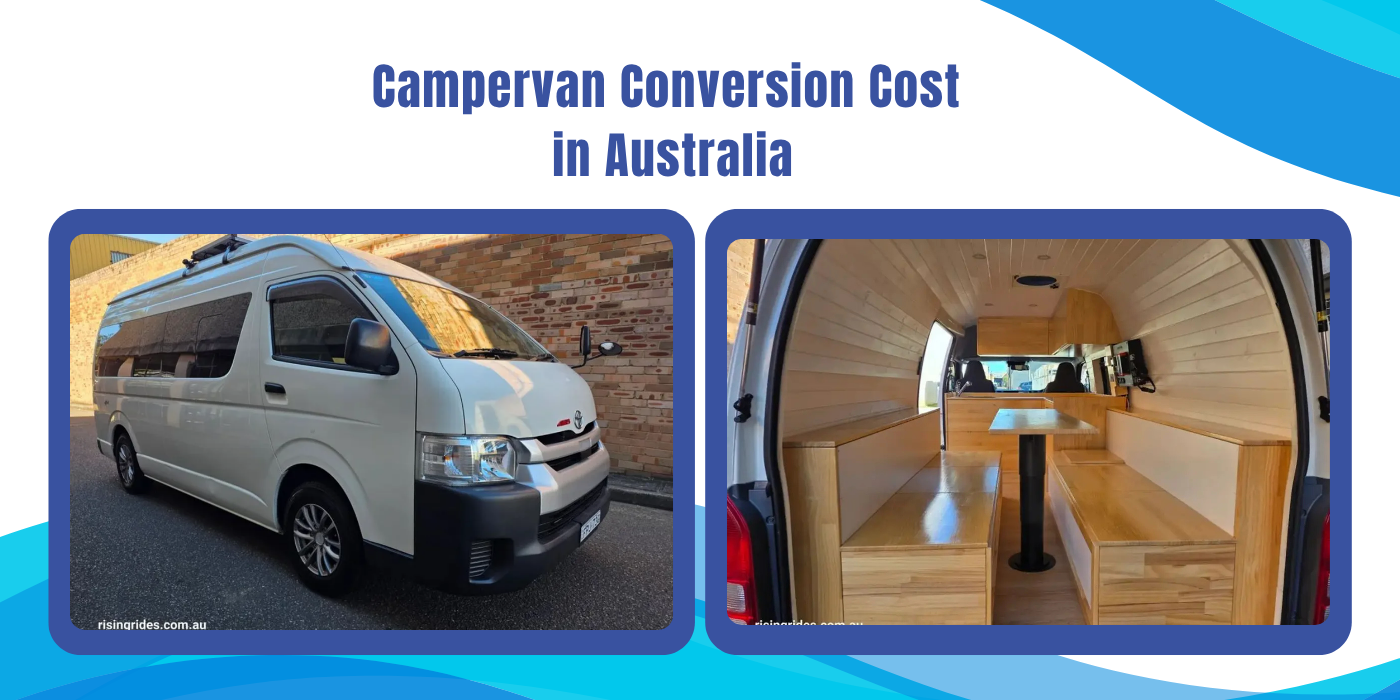
A campervan conversion in Australia in 2026 costs between $3,000 and $60,000+ depending on the build level, the van, and whether you do it yourself or hire a professional. A basic DIY setup runs $3,000 to $8,000. A mid-range comfortable build costs $10,000 to $25,000. A full professional touring conversion with solar, lithium batteries, kitchen, and bathroom ranges from $25,000 to $60,000 or more, not including the cost of the van itself.
Campervan registrations in Australia hit an all-time record of almost 859,000 in 2023, a 21% jump from four years earlier. More Australians than ever are converting vans for road trips, extended travel, and full-time van life. But most people underestimate what a conversion actually costs before they start.
This guide breaks down the real 2026 costs of converting a campervan in Australia, component by component and build tier by build tier, so you can plan your budget accurately before you spend a dollar. And if you want to skip the build entirely, we will show you exactly what Rising Rides has available right now, from base vans ready for conversion to fully converted campervans you can drive away this week.
Should You Build Your Own or Buy Already Converted?
This is the most important question to answer before you spend anything. Both paths have genuine merit. The right one depends on your time, budget, and how soon you want to be on the road.
Option 1: Buy a Base Van and Convert It Yourself
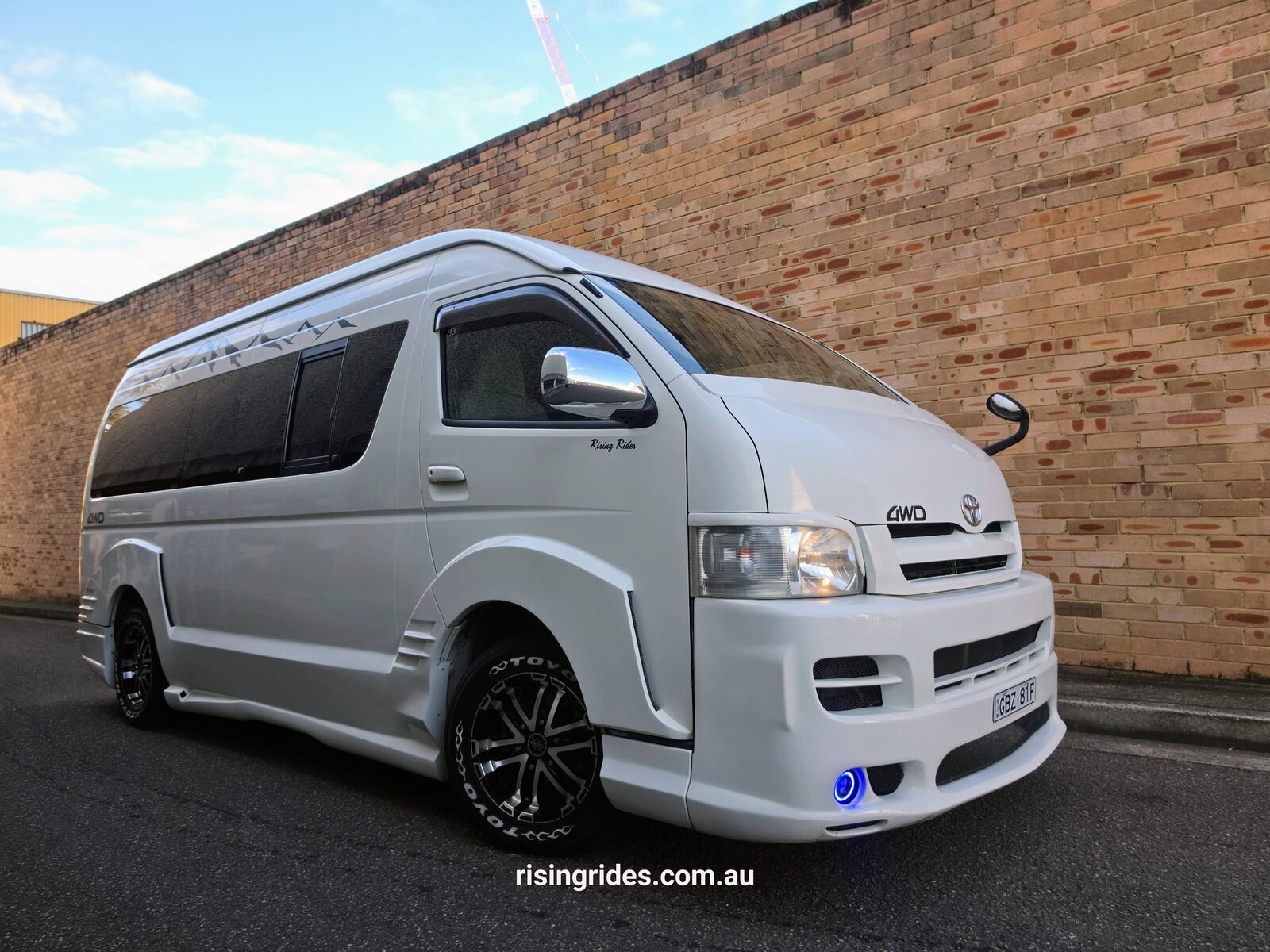
If you want a build tailored exactly to your needs, or you enjoy a hands-on project, starting with a clean base van gives you full control. You choose the layout, the materials, the electrical system, and the fitout. The most popular base van for campervan conversion in Australia is the Toyota HiAce KDH206K in LWB High Roof 4WD configuration, and it is exactly what Rising Rides specialises in.
Our current unconverted HiAce 4WD vans available for conversion:
- 2010 Toyota HiAce KDH206K LWB 4WD High Roof, 5-Seater | $29,900 with 181,708 km
- 2010 Toyota HiAce KDH206K LWB High Roof 4WD | $32,900 with 165,188 km
- 2013 Toyota HiAce KDH206K LWB 4WD High Roof Tourer with factory roof side windows, 5-Seater | $33,900 with 172,263 km
- 2014 Toyota HiAce KDH206K LWB High Roof 4WD | $34,900 with 193,255 km
- 2014 Toyota HiAce KDH206K LWB High Roof 4WD | $35,900 with 253,841 km
All are diesel, all are automatic, and all have been inspected before listing. Looking for a more affordable entry point? The 2000 Mazda Bongo Friendee at $21,900 with 145,623 km is a compact option with a pop-up roof tent already built in, making it a good budget conversion base.
Option 2: Buy an Already Converted Campervan and Drive Away
If months of weekend building does not appeal to you, Rising Rides has fully converted campervans ready to go right now. Every one has been inspected, priced honestly, and is available to view in person at our Lidcombe NSW yard.
Our current converted campervan stock:
- 1994 Toyota HiAce LH123 SLWB Grand Cabin Extra High Roof Campervan | $28,900 with only 132,300 km. The Grand Master. An iconic extra-high roof layout with genuine low kilometres and a full campervan fitout.
- 1997 Toyota HiAce SLWB High Roof Campervan | $29,900 with 104,698 km. The Camper Legend. Seats 7 and sleeps 3 to 4 people. A proven layout for families and group travel.
- 2011 Toyota HiAce 4WD High Roof Campervan | $48,800 with 177,441 km. The Silver Fox. Pristine condition with full 4WD capability.
- 2018 Toyota HiAce 4WD Super LWB Camper 2.8TD 6-speed Auto | $67,800 with only 139,000 km. Off-grid ready with diesel heating already installed. Winter capable and adventure ready.
When you buy a converted campervan from Rising Rides, you skip the build entirely. No tools, no weeks of work, no budget blowouts. The conversion is done, the vehicle is inspected, and it is ready to register and drive. Browse all current stock at risingrides.com.au/cars.
Campervan Conversion Cost Tiers in Australia 2026
Budget DIY Build | $3,000 to $8,000
This tier covers the basics. You get insulation, a ply bed platform, a simple 12V electrical setup, a portable LPG stove, and LED lighting. There is no running water, no fixed kitchen cabinetry, and no solar beyond a basic panel. It is functional for short trips and weekenders but not comfortable for extended travel or full-time van life.
Who it suits:
- Backpackers and first-time builders
- Weekend travellers
- People who want to try van life before committing to a bigger build
Best base van from Rising Rides for this tier: The 2000 Mazda Bongo Friendee at $21,900 is the most affordable starting point in our current stock. Compact, reliable, and already has a pop-up roof tent for extra headroom.
Mid-Range DIY or Semi-Professional Build | $10,000 to $25,000
This is the most popular tier among Australian van lifers in 2026. It covers proper insulation, a fixed bed with under-storage, a 12V compressor fridge, 200 to 400W solar, a lithium battery system, a basic kitchen with sink and running water, and LED lighting throughout.
Who it suits:
- Couples and solo long-term travellers
- People planning extended road trips across Australia
- Anyone wanting a comfortable and functional build without going fully custom
Best base van from Rising Rides for this tier: Any of our Toyota HiAce KDH206K 4WD LWB High Roof vans starting from $29,900. The high roof gives you standing room. The 4WD gives you access to remote campsites. All diesel and automatic.
Full Professional Build | $25,000 to $60,000+
This tier includes everything in the mid-range build plus custom cabinetry, a full bathroom, a diesel heater, a premium lithium off-grid electrical system, and a pop-top roof conversion. Every component is purpose-built and finished to a high standard.
Who it suits:
- Full-time van lifers and families
- People who want a vehicle that functions as a genuine home on wheels
- Anyone who wants professional compliance and a warranty on their fitout
Shortcut for this tier: Buy our 2018 Toyota HiAce 4WD Super LWB Camper at $67,800. It is already off-grid ready with diesel heating installed, only 139,000 km, and ready to drive away without a single weekend of building.
Campervan Conversion Cost Breakdown by Component
Insulation
Insulation is one of the most important investments in any Australian conversion. Australian summers are extreme. Poor insulation means a van that is unbearable in Queensland, the Northern Territory, or Western Australia.
- Foam board insulation (XPS or polyiso): $200 to $500
- Spray foam insulation: $800 to $2,000
- Thinsulate (3M): $600 to $1,500
- Sheep's wool or Havelock wool: $700 to $1,800
For Australian conditions, particularly anyone travelling in summer or through tropical and outback regions, Thinsulate or spray foam are strongly recommended over basic foam board. Budget an additional $150 to $300 for a thermal reflective barrier on the roof panel.
Flooring
Flooring needs to be durable, water-resistant, and thermally effective. Most Australian builds use vinyl plank flooring laid over a plywood subfloor.
- Ply subfloor only: $100 to $300
- Vinyl plank over ply: $300 to $700
- Coindot or rubber flooring: $200 to $500
- Professional installation (labour): $300 to $800
Wall and Ceiling Lining
Ply lining is the most common choice in Australian conversions due to its cost, workability, and visual appeal when sanded, oiled, or painted.
- Ply lining materials (walls and ceiling): $300 to $900
- Fabric-wrapped panels: $500 to $1,200
- Professional lining installation (labour): $600 to $2,000
Bed Platform and Sleeping Setup
The bed is the most-used piece of furniture in any campervan. Getting it right matters more than almost any other component.
- Simple fixed ply platform plus mattress: $200 to $800
- Fixed platform with under-bed storage: $400 to $1,200
- Rock and roll or fold-out bed: $800 to $2,500
- Pop-top roof conversion for HiAce (professionally fitted): $8,000 to $13,000+
- Custom-cut memory foam mattress: $200 to $600
Electrical System
The electrical system is the most technically complex and most variable cost in any conversion. It powers your fridge, lighting, fan, phone and laptop charging, and any appliances you run off-grid.
- Basic 12V setup (single AGM battery, split charge relay, USB, LED lights): $500 to $1,500
- Mid-range solar and AGM (200W solar, MPPT, 100 to 200Ah AGM, inverter): $1,500 to $3,500
- Lithium off-grid system (200 to 400W solar, MPPT, 100 to 200Ah LiFePO4, BMS, 2000W inverter): $4,000 to $10,000
- Full premium off-grid (400W+ solar, 300Ah+ Victron lithium, Victron inverter/charger, DC-DC charger): $8,000 to $20,000+
AGM vs Lithium Batteries for Australian Campervan Conversions
AGM batteries cost $150 to $300 per 100Ah but provide only 50% usable capacity and last 300 to 500 charge cycles. Lithium iron phosphate (LiFePO4) batteries cost $500 to $1,200 per 100Ah but provide 80 to 100% usable capacity and last 2,000 to 5,000+ cycles. For extended Australian travel, lithium is almost always the better long-term investment. Reputable brands in the Australian market include Victron Energy, Enerdrive, and REDARC.
Solar Panels for Australian Conditions
Australia's solar resource is among the best in the world, making solar-powered van life highly practical. Costs are approximately:
- 200W rigid solar panel: $200 to $400
- 400W setup (two panels): $400 to $800 in panel cost alone
- MPPT solar controller: $150 to $400
- Flexible panels: more expensive and less efficient, but suit low-profile roof setups
Kitchen Fitout
- Basic camp setup (portable LPG stove, simple bench, no sink): $200 to $600
- Mid-range kitchen (built-in 2-burner stove, 12V compressor fridge, basic sink): $1,500 to $4,000
- Full kitchen fitout (custom cabinetry, induction cooktop, 60 to 80L fridge, pressurised water, stainless sink): $4,000 to $10,000+
12V Compressor Fridge
A quality 12V compressor fridge is arguably the most important appliance in an Australian campervan. A reliable 40 to 60L unit costs $700 to $1,500. Reputable brands available in Australia include Dometic, Engel, ARB Elements, and National Luna. Cheaper alternatives use significantly more power and fail sooner, particularly in Australian summer heat.
Water System
- Basic jerry can and hand pump sink: $100 to $400
- Undersink fresh water tank (20 to 40L) with 12V pump and tap: $400 to $900
- Full water system (fresh tank, grey tank, pump, hot water): $1,200 to $3,500
- Hot water system (diesel or instantaneous gas): $400 to $1,200
- Outdoor shower setup: $200 to $800
For travel in remote Australia, including the outback, Western Australia, or the Top End, budget for a minimum 60 to 100 litre fresh water tank and a quality filtration system.
Ventilation
A roof vent fan is essential in Australian summer conditions. It provides passive and powered airflow and manages condensation in cooler months.
- Basic manual roof vent: $80 to $200
- Fan-Tastic or Maxxair powered fan vent: $250 to $500
- Dometic FreshJet roof air conditioner (12V): $1,500 to $3,500 installed
Heating
Heating is important for anyone spending nights in alpine areas, Tasmania, or southern Australia in winter.
- Portable LPG or propane heater: $150 to $400
- Diesel air heater (Webasto, Espar, or budget unit): $300 to $1,500 installed
- Diesel hydronic heater (Webasto): $2,000 to $4,000 installed
Extras and Often-Forgotten Costs
These costs are easy to overlook but add up quickly in any build:
- Roof rack: $400 to $1,500
- Portable or cassette toilet: $150 to $600
- Window tinting (privacy and thermal): $300 to $800
- Fly screens and mosquito mesh: $100 to $400
- Awning (Fiamma or ARB): $400 to $1,500
- Security deadlocks or slam locks: $200 to $700
- Curtains and privacy blinds: $150 to $600
- Table and seating: $100 to $800
- Contingency buffer: always add 10 to 20% to your total budget
First-time builders regularly overspend their initial estimate by 20 to 30%. A contingency buffer is not optional, it is essential.
Total Campervan Conversion Cost Summary | Australia 2026
Here is a full cost summary across all three build tiers, including the base van.
Base van (Toyota HiAce)
Budget DIY: $25,000 to $30,000 | Mid-Range DIY: $28,000 to $38,000 | Full Professional: $35,000 to $55,000
Insulation
Budget DIY: $200 to $400 | Mid-Range DIY: $600 to $1,500 | Full Professional: $1,000 to $2,500
Flooring and wall lining
Budget DIY: $300 to $700 | Mid-Range DIY: $700 to $1,800 | Full Professional: $1,500 to $4,000
Bed platform
Budget DIY: $200 to $600 | Mid-Range DIY: $600 to $1,500 | Full Professional: $1,500 to $5,000
Electrical system
Budget DIY: $500 to $1,500 | Mid-Range DIY: $2,000 to $5,000 | Full Professional: $5,000 to $15,000
Solar
Budget DIY: $400 to $800 | Mid-Range DIY: $800 to $2,000 | Full Professional: $2,000 to $6,000
Kitchen fitout
Budget DIY: $300 to $800 | Mid-Range DIY: $1,500 to $4,000 | Full Professional: $4,000 to $10,000
12V fridge
Budget DIY: $300 to $600 | Mid-Range DIY: $700 to $1,200 | Full Professional: $1,200 to $2,500
Water system
Budget DIY: $100 to $400 | Mid-Range DIY: $500 to $1,500 | Full Professional: $1,500 to $4,000
Ventilation
Budget DIY: $80 to $200 | Mid-Range DIY: $300 to $600 | Full Professional: $600 to $3,500
Heating
Budget DIY: $0 to $400 | Mid-Range DIY: $400 to $1,000 | Full Professional: $1,000 to $4,000
Extras and contingency
Budget DIY: $500 to $1,000 | Mid-Range DIY: $1,000 to $3,000 | Full Professional: $3,000 to $10,000
Total including van
Budget DIY: $28,000 to $38,000 | Mid-Range DIY: $38,000 to $62,000 | Full Professional: $58,000 to $125,000+

Why the Toyota HiAce KDH206K 4WD Is the Best Conversion Base in Australia
If you are going to spend months building a campervan, start with the right foundation. The Toyota HiAce KDH206K 4WD LWB High Roof is regarded by Australian van lifers as the gold standard base for off-road capable campervan conversions, and it is the vehicle Rising Rides knows better than any other.
Here is why it stands above every alternative:
- 4WD capability: Access fire trails, outback tracks, beach entry points, and remote campsites that rear-wheel-drive vans cannot reach
- 1KD-FTV 3.0L turbo diesel engine: Proven, rebuildable, and supported by mechanics right across Australia
- LWB High Roof body: Maximum usable interior length and standing room, essential for a liveable conversion
- Automatic transmission: Easier and safer to drive fully loaded on corrugated outback roads
- Strong resale value: Toyota HiAce 4WD campervans hold their value better than almost any other converted vehicle in Australia
- Parts availability: Stocked at every major Toyota dealer and most independent parts suppliers nationally
Rising Rides currently stocks multiple KDH206K 4WD vans priced from $29,900 to $35,900. All are diesel, all are automatic, and all have been inspected before listing. View current availability at risingrides.com.au/cars.
DIY Conversion Kits Available in Australia (2026)
A campervan conversion kit is a pre-designed, pre-cut set of modular components, typically flat-pack plywood panels with hardware and instructions, that lets you convert your van without starting completely from scratch. Kits are a good middle ground between a full custom build and a professional conversion.
Available kits in Australia in 2026 specifically designed for the Toyota HiAce:
- Vanlifer HAHEI Kit (Toyota HiAce): from AUD $2,752 | compact, simple bed and storage layout
- Vanlifer MAITAI Kit (HiAce and mid-size vans): from AUD $3,822 | front dining, rear kitchen
- Vanlifer PIHA Kit (Toyota HiAce): from AUD $5,351 | twin-sofa layout with kitchen, bed, and storage
- Vanlifer ABEL Kit (Toyota HiAce): from AUD $5,351 | twin rear sofa and front kitchen, the most popular HiAce layout
- Vanlifer WAIHI Kit (Transit, Sprinter, Deliver 9): from AUD $9,480 | raised bed, second bed, fridge and toilet space
- Nomad Vans kits (HiAce, iLoad, most mid-size vans): from approximately $3,500, with a Sydney workshop installation option
These kits cover furniture and structural elements only. Insulation, electrical systems, solar, water, and appliances are sourced separately on top of the kit price.
How much does a campervan conversion cost in Australia in 2026?
A campervan conversion in Australia in 2026 costs between $3,000 and $60,000+ for the conversion alone, not including the van. A basic DIY conversion costs $3,000 to $8,000. A mid-range build with solar, lithium battery, kitchen, and water system costs $10,000 to $25,000. A full professional conversion with custom cabinetry, off-grid power, and bathroom costs $25,000 to $60,000+. Total cost including the base van ranges from approximately $28,000 to $125,000+.
Is it cheaper to build your own campervan or buy one already converted?
Building your own is generally cheaper in materials but costs significant time. A mid-range DIY build on a Toyota HiAce 4WD all-in typically costs $38,000 to $62,000. A pre-converted campervan from Rising Rides starts from $28,900 for the 1994 HiAce Grand Cabin and goes to $67,800 for the 2018 4WD Super LWB off-grid Camper. For many buyers, purchasing a pre-converted vehicle from Rising Rides works out comparable in total cost once you factor in tools, materials, and the value of your time spent building.
What is the best van to convert to a campervan in Australia?
The Toyota HiAce KDH206K 4WD LWB High Roof is the best base van for campervan conversion in Australia in 2026. It combines 4WD capability, a proven 3.0L turbo diesel engine, maximum interior space, strong resale value, and nationwide parts availability. Rising Rides specialises in this exact model and currently stocks multiple examples from $29,900. Browse available stock at risingrides.com.au/cars.
What is the cheapest way to convert a van to a campervan in Australia?
The cheapest approach is a DIY build using affordable materials:
- Foam board insulation: $200 to $400
- Ply bed platform: $200 to $400
- Basic 12V electrical setup: $500 to $1,000
- Portable LPG stove: $100 to $200
- LED lighting: $100 to $300
A functional basic DIY conversion can be completed for $3,000 to $5,000 in materials. The 2000 Mazda Bongo Friendee at $21,900 from Rising Rides is a good budget base for a compact build with minimal spend.
How long does a campervan conversion take?
- Basic DIY: one to two weeks full-time, or two to four months on weekends
- Mid-range DIY: three to six months part-time
- Professional conversion: four to twelve weeks depending on complexity and bookings
- Full custom professional build: four to six months
If you do not have that kind of time, a pre-converted campervan from Rising Rides is ready to drive away this week.
Is AGM or lithium battery better for a campervan in Australia?
Lithium iron phosphate (LiFePO4) is the better choice for most Australian builds because:
- It provides 80 to 100% usable capacity versus 50% for AGM
- It weighs significantly less for the same storage capacity
- It lasts five to ten times longer at 2,000 to 5,000+ charge cycles
- It charges faster, which matters when solar is your primary source of power
AGM costs $150 to $300 per 100Ah. Lithium costs $500 to $1,200 per 100Ah. Over a five to ten year build life, lithium is almost always the more cost-effective choice for frequent travellers.
Can I insure a self-converted campervan in Australia?
Yes. Specialist insurers including CMI Insurance, Youi, and NRMA offer policies for converted vehicles. Key requirements typically include:
- A completed vehicle modification inspection in your state
- Accurate stated value of the vehicle and the conversion
- Full disclosure of all modifications to the insurer
Undisclosed modifications can void a claim, so always be transparent with your insurer from the start.
Do I need approval to convert a van in Australia?
Requirements vary by state and by the type of modification. Key points are:
- Significant structural modifications such as a pop-top roof or bathroom installation may require an engineer's certificate
- A vehicle inspection before re-registration may be needed after major structural changes
- New vehicles modified professionally require second-stage manufacturer (SSM) compliance under the Australian Design Rules
- Check requirements with your state road authority: Transport for NSW, VicRoads, TMR Queensland, or equivalent
How much does solar cost for a campervan conversion in Australia?
- Basic 200W setup with MPPT controller and wiring: $500 to $900 in materials
- Mid-range 300 to 400W system with a Victron SmartSolar MPPT controller: $1,000 to $2,500
- Premium off-grid system with 400W+ solar and 200 to 300Ah lithium battery: $4,000 to $10,000
Australia's high solar irradiance makes even a modest setup highly effective for day-to-day power needs on the road.
Conclusion
A campervan conversion in Australia is one of the most rewarding projects you can take on, but it is not cheap and it is not quick. Costs range from $3,000 for a minimal DIY build to well over $100,000 for a fully custom professional vehicle.
The most important decision you will make is which base van you start with. The Toyota HiAce KDH206K 4WD LWB High Roof is the best starting point for most Australian buyers in 2026, and it is the vehicle Rising Rides knows better than any other.
We give you two options. If you want to build your own, we have inspected 4WD HiAce base vans available from $29,900. If you want to skip the build entirely, we have fully converted campervans ready to drive away from $28,900.
Either way, Rising Rides is the place to start. Visit our full stock at risingrides.com.au/cars, call us on 0478 901 002, or email info@risingrides.com.au. Our yard is at 16A Adderley Street, Lidcombe NSW 2141 and we are happy to arrange a viewing any day of the week.