
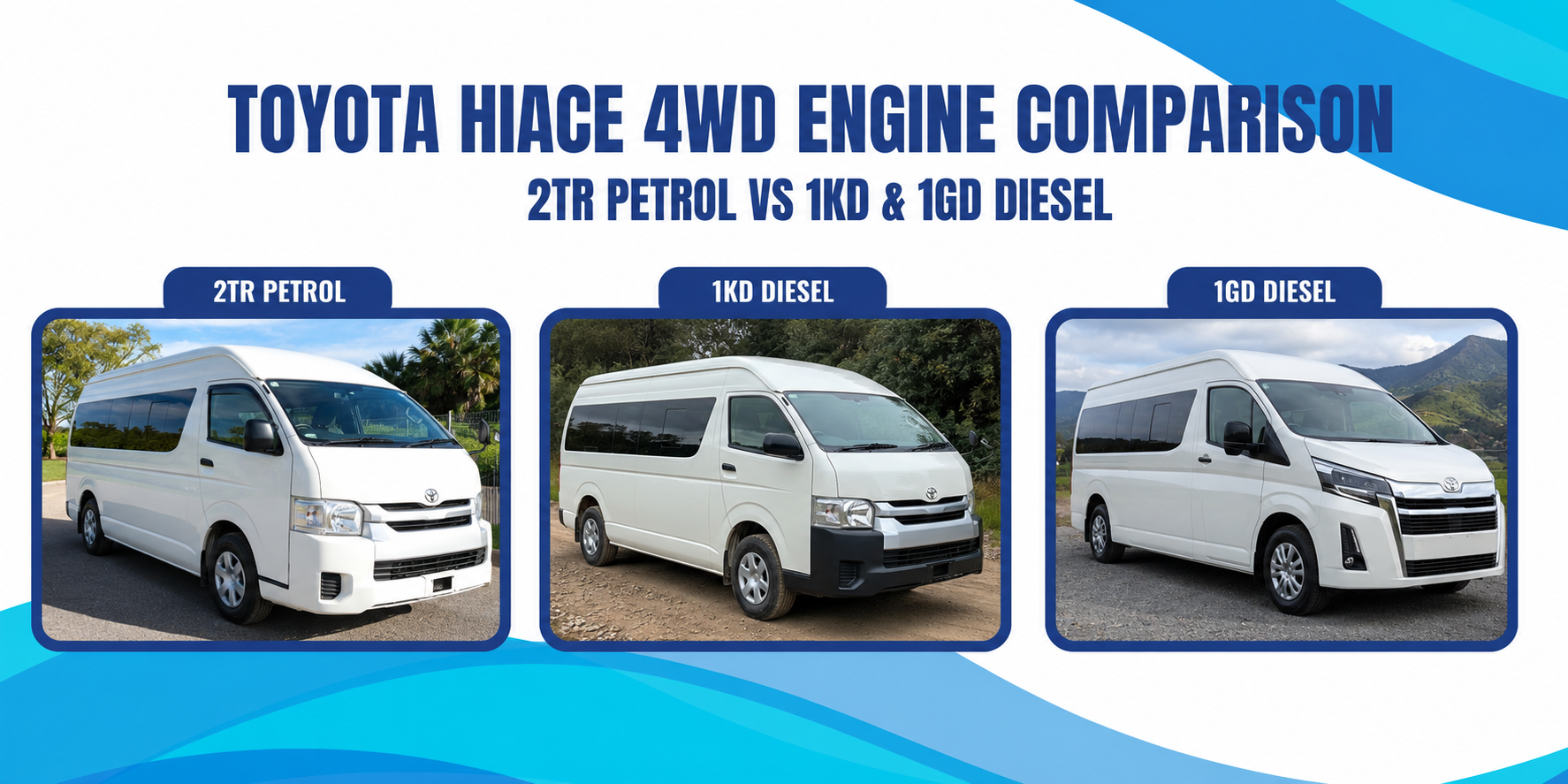
If you're weighing up a HiAce 4WD in Australia as the base for a camper build, here's the short version before we get into the detail: the 1GD-FTV diesel is the pick for serious outback touring, because diesel is easier to find at remote roadhouses, it delivers more range between fills, and its low-down torque suits a loaded van on dirt, sand or towing a trailer. The 2TR-FE petrol is a genuine option if your trips are shorter, closer to town, and you value simpler mechanicals with no DPF to worry about. The older 1KD-FTV sits in between - tougher and simpler than the 1GD, but thirstier and harder to find in newer stock.
That's the summary. Now let's unpack the fuel economy, range, torque, towing and reliability side of a 2TR petrol vs 1GD diesel decision properly, because a $100k-plus camper build deserves more than a one-line answer - and because we live and breathe this exact question every day at our yard in Lidcombe.
A quick note on who's writing this: we're Rising Rides, a boutique Japanese import dealership based in Lidcombe, Sydney, specialising in genuine 4WD HiAce vans, campervans and motorhomes. We're not a generalist used car lot that happens to stock a HiAce or two - 4WD HiAce vans are basically all we do, sourced directly from Japanese auction houses and prepared to our own handover standard before they ever reach a customer. You can read more about how we got started on our About page. Everything below is written from that vantage point: real stock we've sold, real questions we field from customers standing in our yard, and a genuine passion for getting Australians into the right van for the way they actually camp.
What Is a 4WD HiAce, Really?
Before comparing engines, it's worth being upfront about something a lot of first-time buyers don't realise: Toyota Australia has never sold a factory 4WD HiAce through local dealers. Every 4WD HiAce on Australian roads today falls into one of two categories, and which one you end up with changes the whole conversation about engines.
JDM Factory 4WD Imports
In Japan, Toyota built genuine factory 4WD HiAce vans across several generations, badged with chassis codes like KDH206 (1KD-FTV diesel), GDH206 (1GD-FTV diesel) and TRH-series (petrol, including 1TR-FE and 2TR-FE/2.7 VVT-i variants). These are imported into Australia under used-import approval schemes, usually with an odometer limit around 80,000km on the newer diesel and petrol codes. The import process - auction purchase, shipping, compliance, ADR/RAV entry - typically takes six to ten weeks from Japan to driveway, and eligible stock moves week to week, so what's available today may not be there next month.
This is exactly the segment we specialise in. We buy direct from established Japanese auction channels including USS, TAA and HAA, rather than through a middleman, which means we're inspecting genuine auction sheets and mileage history ourselves before a van ever gets a landed price. Every vehicle that comes through our doors in Lidcombe goes through the same process before it's offered for sale: oil and fluid levels checked and topped, an independent NSW roadworthy inspection, a full detail inside and out, and a clear PPSR check with no hidden finance or write-off history. What we know about a vehicle is exactly what you'll know - no spin, no surprises. It's also why nearly every van we sell carries genuine, storied names rather than a stock number - vans like our 2019 GDH206K 1GD "GD Cruiser," our 2012 KDH206K 1KD "Trailmaster," and our 2014 TRH226K 2TR "The Shark" all came through this exact process before they went anywhere near a customer. You can browse all of these and more on our current stock list, or head straight to our dedicated 4WD HiAce campervan range if a fitted-out camper is what you're after.
Aftermarket 4WD Conversions in Australia
The second path is a locally engineered conversion, most notably through approved second-stage manufacturers. One well-known Australian example fits a 2.8L 1GD-FTV turbo-diesel with a six-speed auto, a Land Cruiser 200-derived drivetrain, low-range gearing, a centre transmission, optional rear diff lock, and a suspension lift for clearance. These builds are pitched as a genuine Troop Carrier alternative rather than a bolt-on lift kit, with a GVM around 4,000kg and towing capacity around 1,500kg.
Either path gets you a HiAce 4WD in Australia capable of a proper camper conversion - but it does mean your engine choice is really a choice between whichever donor vehicle or import stock you can source, so it pays to understand all three engines before you commit to a shell. We'd rather talk you through this honestly upfront than have you find out the hard way six months into ownership, which is a big part of why this guide exists.
The Engine Line-Up: 2TR Petrol vs 1KD and 1GD Diesel
2TR-FE 2.7L Petrol
The 2TR-FE (and its smaller 1TR-FE 2.0L sibling) is Toyota's long-running petrol four-cylinder, shared with the HiLux, Prado and Fortuner. It's naturally aspirated, mechanically simple, and doesn't carry a diesel particulate filter, turbocharger or common-rail injection system to maintain. That simplicity is its main selling point for camping use - fewer emissions components means fewer things to go wrong on a remote track, and servicing is generally cheaper per visit.
The trade-off is fuel use. Petrol AWD/4WD HiAce variants running the 2TR engine can return figures upwards of 14L/100km once loaded with camper gear, and even in more favourable conditions most owners report somewhere in the 10–12L/100km range for daily driving. We've had plenty of customers come in expecting diesel-like economy from a petrol 4WD and be genuinely surprised at the bowser - it's a conversation we have often, and one reason we always push customers to think about their actual trip pattern before falling in love with a particular van.
1KD-FTV 3.0L Turbo-Diesel
The 1KD-FTV is the older of the two diesel options, fitted to KDH206-series HiAce and shared with the same-era Prado and HiLux. It's a 3.0-litre turbo-diesel that prioritises displacement and mechanical durability over sophisticated electronics. Many owners and workshops describe it as the "old faithful" of the pair - less refined, a bit noisier, but with a reputation for shrugging off high kilometres when serviced properly.
Our own 2012 KDH206K "Trailmaster" is a good example of what this engine looks like once it's been properly cared for - a genuinely usable, honest touring platform rather than a temperamental old workhorse. It's the kind of van we're happy to put our name on.
1GD-FTV 2.8L Turbo-Diesel
The 1GD-FTV replaced the 1KD in the GDH206-series HiAce and is the engine used in most current-generation imports and conversions, including the 300-series HiAce. Despite being 0.2L smaller in capacity, a variable-nozzle turbocharger and more advanced common-rail injection let it out-produce the older 1KD on both power and torque. In HiAce tune it makes roughly 110kW and 300Nm - modest numbers on paper, but the torque arrives from around 1,000rpm, which is exactly the delivery you want for pulling a loaded van through soft sand or up a steady outback incline. It's also noticeably quieter and smoother than the 1KD, and built to meet stricter Euro emissions standards, which is part of why it burns less fuel per kilometre.
If you've spent any time browsing our stock list, you'll notice this is currently the engine we see the most demand for, and vans like our 2019 GDH206K "GD Cruiser" tend not to sit around long. It's the newer, more refined half of the diesel conversation, and for a lot of buyers building a serious campervan it's the natural starting point.
Fuel Economy and Range Between Fills
This is where the 2tr petrol vs 1gd diesel debate really gets decided for anyone planning genuine outback distances.
Real-World Consumption Figures
Engine Typical consumption (loaded, mixed conditions) 2TR-FE petrol (2.7L) ~10–14 L/100km 1KD-FTV diesel (3.0L) ~7.5–9.5 L/100km 1GD-FTV diesel (2.8L) ~7.5–9.0 L/100km These are guide figures, not lab numbers - actual consumption depends heavily on load, tyre choice, terrain, speed and how the van is driven. A camper fitout with a full water tank, batteries, solar and gear will push any of these engines toward the higher end of their range, and unsealed roads or soft sand will push them higher again.
Tank Size and Range Between Fills
The practical impact of that consumption gap is range. A diesel HiAce running the 1GD or 1KD will typically stretch 150–200km further on a full tank than the equivalent petrol 2TR van, simply because diesel uses less fuel per kilometre for a similar-sized tank. On routes like the Gibb River Road, the Great Central Road or the Tanami Track - where fuel stops can be several hundred kilometres apart - that extra range isn't a nice-to-have, it can be the difference between a comfortable margin and running the tank down to fumes.
If your camping is mostly weekend trips within a few hundred kilometres of home, this gap matters far less, because you're never far from a servo regardless of what's in the tank.
How This Plays Out in the Real World
We hear this question constantly from customers standing in front of our stock: "will I actually notice the difference between petrol and diesel on my trips?" Honestly, the answer depends entirely on where you're headed. A young family doing school-holiday loops around the NSW coast, the Blue Mountains, or up to the Gold Coast hinterland will barely notice the extra litres a 2TR petrol drinks, because they're never more than an hour from three or four servos at any given time. But the moment a trip starts involving genuinely remote legs - think crossing from Alice Springs to Uluru, tackling the Savannah Way, or running the length of the Great Central Road - the fuel-economy gap between petrol and diesel compounds fast, and it's the diesel owners who tend to arrive relaxed rather than watching the fuel gauge with white knuckles.
Diesel and Unleaded Availability at Outback Roadhouses
Fuel economy is only half the equation - the other half is whether you can actually buy the fuel your engine needs once you're off the highway.
Diesel Availability
Diesel is the default fuel of the outback. Road trains, mining traffic, grey nomads towing caravans, and 4WD tourers overwhelmingly run diesel, so remote roadhouses stock it as a priority, often with multiple bowsers and larger underground tanks to match demand. On genuinely remote routes through the Kimberley, the Centre, the Nullarbor and Cape York, diesel supply is rarely the limiting factor.
Unleaded/Petrol Availability
Standard unleaded is also widely available at roadhouses because most passenger cars and 4WDs on the road still run petrol, so this isn't a case of the 2TR being left stranded. Where it gets trickier is premium unleaded (95/98 RON): some smaller, more remote roadhouses only stock standard 91 RON, and if your particular HiAce variant is tuned to prefer or require a higher octane, that's worth checking against the specific import's handbook before you commit to a fuel type for touring.
Why This Matters for Remote Touring
The real-world takeaway is that diesel gives you a slightly wider safety margin on genuinely remote legs - more range per tank, plus fuel that's stocked in depth at almost every roadhouse. Petrol is perfectly fine for touring closer to sealed highways and larger regional towns, where fuel choice at any given servo is rarely in question. It's genuinely one of the first questions we ask any customer walking through our doors: "where are you actually planning to take this thing?" The answer usually tells us more about which engine suits them than any spec sheet does.
Low-Range Torque, Towing Capacity and Load Carrying
Torque Delivery Compared
This is arguably the biggest practical difference for a loaded camper van. The 1GD-FTV's 300Nm arrives from roughly 1,000rpm, giving strong, low-rev pulling power in low range - ideal for soft sand, steep dirt tracks, or simply pulling away smoothly with a heavy fitout on board. The 1KD-FTV delivers its torque a little differently, in keeping with its older-generation turbo-diesel character, but still comfortably out-torques the petrol option at low revs. The 2TR-FE, being naturally aspirated and petrol, needs higher revs to make similar pulling power, which means more throttle, more noise and more fuel burnt to achieve the same result off-road.
GVM and Payload for Camper Fitouts
A camper conversion adds up fast - cabinetry, water tanks, batteries, solar, a bed platform, awnings, recovery gear and personal effects can easily add several hundred kilograms to a bare shell. Aftermarket 4WD HiAce conversions built for touring are commonly rated with a GVM around 4,000kg, and factory JDM 4WD variants carry payload figures around 1,000kg once fitted out - both comfortably ahead of what many full-size 4WD wagons offer once passengers and gear are loaded, where usable payload can shrink to just a few hundred kilograms. Whichever engine you choose, always weigh the finished van, not just the spec sheet - a loaded HiAce camper is a genuinely heavy vehicle and GVM compliance matters for both safety and insurance.
This is also where our upgraded solar packages come into the conversation. We now offer upgraded off-grid solar setups on our campervan range for buyers who want to go further and stay off-grid longer without running a generator - but any added battery and panel weight needs to be accounted for in your payload budget just like everything else, so we always talk customers through what their final loaded weight will realistically look like before they drive away. If budget is part of that conversation too, our finance and trade-in options are worth a look before you decide on a build.
Towing Capacity
Towing figures vary by build and import specification, but a well-specified 4WD HiAce conversion can be rated around 1,500kg braked towing capacity - enough for a small off-road trailer, a boat, or a basic camper trailer, though not in the same league as a 3,500kg-rated ute or wagon. If your plans include towing a heavier van behind the HiAce itself, check the specific build's rating carefully rather than assuming it matches HiLux or Prado figures, since GVM and chassis differences change the numbers.
Reliability and Known Issues by Engine
Reliability is the part of this decision that shows up months and years down the track, not on day one - so it deserves proper attention, and it's the number one thing we get asked about before anyone talks money.
2TR-FE Petrol Reliability
The 2TR-FE is mechanically straightforward and has a solid reputation across the HiLux and Prado range it's shared with. Because it lacks a turbocharger, DPF or high-pressure common-rail system, there's simply less to fail, and it tolerates lower-quality fuel and infrequent short trips better than either diesel. The main complaint from owners isn't reliability - it's fuel use, with some 4WD petrol conversions returning 14L/100km or more, well above what buyers expect coming from a diesel background.
1KD-FTV Reliability
The 1KD-FTV has a mixed but generally well-regarded reputation for durability, provided servicing is kept up. As with most timing-belt diesels of its era, a missed timing belt interval is the single biggest risk - a snapped belt causes catastrophic internal engine damage, so this is non-negotiable maintenance, not a service you can stretch. Freewheeling hub servicing is another item that needs periodic attention on 4WD variants; stiff or seized hubs stop 4WD engaging properly when you actually need it. Rust on older shells, particularly floor pans, rear wheel arches and underbody sections, is also worth inspecting closely on any high-kilometre JDM import.
1GD-FTV Reliability and DPF Considerations
The 1GD-FTV is the more modern and, on paper, more advanced engine - smoother, quieter and more efficient than the 1KD it replaced. The trade-off is emissions-control complexity: the diesel particulate filter (DPF) needs periodic high-temperature regeneration to burn off accumulated soot, and short, slow, stop-start driving prevents that regeneration from happening properly. For a camping vehicle that's mostly doing long, steady highway and outback running, this is rarely a problem - the DPF gets the sustained heat it needs. For a HiAce used mainly for short suburban trips with occasional camping, DPF blockages and the resulting warning lights or expensive forced regenerations are a genuine risk worth planning for.
Servicing Costs and Parts Availability
All three engines are shared with the HiLux, Prado and Land Cruiser 70 Series, which is good news for hiace engine reliability and running costs generally - none of these are exotic or low-volume engines. Toyota dealers and independent diesel specialists across the country know them well, and parts are common and reasonably priced compared with importing spares for a genuinely rare vehicle. That said, JDM-specific components (some sensors, certain wiring loom sections, right-hand-drive-specific parts on grey imports) can occasionally require a specialist import parts supplier rather than a standard Toyota counter order, so it's worth asking any workshop upfront whether they've serviced 4WD HiAce imports before.
Why We Put Every Van Through the Same Process First
This is exactly why we don't sell a van the day it lands. Every vehicle that comes through Rising Rides - regardless of engine - goes through oil and fluid checks, an independent NSW roadworthy inspection, a deep interior and exterior detail, and a clear PPSR history check before it's offered for sale. Every van we sell also comes fitted standard with a custom Apple CarPlay and Android Auto head unit and reverse camera, and carries genuine AWN-backed mechanical and electrical warranty cover with Australia-wide support. We only accept vans in what we consider perfect condition, and if a vehicle isn't there yet when it lands, we get it there before it goes anywhere near a customer. It's a standard we hold regardless of whether the van in front of us is running a 2TR, a 1KD or a 1GD, because our name goes on it either way.
Which Engine Suits Serious Outback Touring vs Shorter Trips?
Best for Serious Outback Touring: 1GD-FTV (with 1KD-FTV as a Capable Alternative)
If your camping plans genuinely involve remote touring - the Kimberley, the Centre, Cape York, long stretches of the Nullarbor or Gibb River Road - the 1GD-FTV diesel is the stronger base. Its combination of low-down torque for loaded, low-range driving, better fuel economy for longer range between fills, and diesel's superior availability at remote roadhouses adds up to a genuinely more comfortable and lower-risk touring experience. The older 1KD-FTV remains a very capable alternative if you find a well-maintained example, particularly if you value its slightly simpler, non-Euro-6 emissions setup and don't mind the extra noise and thirst compared with the newer engine - just budget for timing belt intervals and hub servicing as non-negotiable maintenance items.
Best for Shorter Trips Closer to Home: 2TR-FE Petrol
If your camping is mostly weekends and short trips within a few hundred kilometres of home - national parks, coastal camping, regional getaways where fuel type is never really in question - the 2TR-FE petrol is a legitimate, lower-maintenance option. You give up some range and low-range pulling power, and you'll burn noticeably more fuel per kilometre, but you gain a simpler engine with no DPF regeneration cycle to manage and generally cheaper routine servicing. For buyers put off by diesel running costs or turbo-diesel complexity, it's a genuinely sensible trade-off provided the trips stay closer to town.
How Our Team Talks Customers Through This Decision
Every fortnight or so, someone stands in our Lidcombe yard genuinely torn between two vans that look almost identical from the outside but couldn't be more different once you understand what's under the bonnet. We don't push people toward whichever van happens to be sitting in stock the longest - we ask about the trip that matters most to them first: is it the big lap, is it towing a boat down the coast, or is it mostly weekends away with the kids? From there the engine choice usually becomes obvious, and it's honestly the part of the job our founder enjoys most. As an avid camper himself, he's personally taken these 4WD HiAce vans further than most people would believe possible, and that hands-on experience is exactly what shapes the advice we give every customer who walks through our door.
Where can I see 4WD HiAce vans with each of these engines in person?
Rising Rides holds a rotating stock list of 2TR petrol, 1KD diesel and 1GD diesel 4WD HiAce vans and campervans at our Lidcombe, Sydney yard, each prepared to the same NSW roadworthy, detailing and warranty standard. Stock moves regularly, so it's worth checking our current list, browsing our 4WD HiAce campervan range, or getting in touch directly so our team can match you to the right engine and build for your trips. Common questions about buying are also covered on our FAQ page.
Conclusion
There's no single "best" engine for every HiAce camper conversion - the right choice depends on where you actually plan to drive it. For serious outback touring, where range between fuel stops and confident low-range torque matter more than anything else, the 1GD-FTV diesel is the standout, with the older 1KD-FTV a solid runner-up if you find a well-cared-for example. For shorter trips closer to home, where fuel availability is never a question and mechanical simplicity is worth more than outright range, the 2TR-FE petrol holds up as a genuine, lower-maintenance alternative. Whichever engine you land on, remember that a 4WD HiAce in Australia is either a JDM factory import or a locally engineered conversion - so factor the reputation of the importer or converter, and the specific vehicle's service history, into the decision just as heavily as the engine badge itself.
If you'd rather talk this through with people who genuinely live and breathe 4WD HiAce vans, that's exactly what we're here for. At Rising Rides, we're a boutique dealership based in Lidcombe, Western Sydney, sourcing direct from Japanese auctions and preparing every van - 2TR, 1KD or 1GD - to the same strict handover standard: oil and fluid checks, independent NSW roadworthy certification, deep detailing, a custom head unit with Apple CarPlay and Android Auto, clear PPSR history, and genuine AWN-backed warranty cover. Once you walk through our door, you're not a customer to us - you're family, and we're happy to stick around long after handover to talk about where you've been. Browse our current stock list or our dedicated 4WD HiAce campervan range, or get in touch on 0478 901 002 or via info@risingrides.com.au, and we'll help you land on the right engine for the way you actually camp.
This guide is general information for Australian buyers researching a 4WD HiAce camper conversion and does not constitute mechanical, financial or purchasing advice. Always have any specific vehicle independently inspected and confirm GVM, towing and fuel specifications for that exact build before purchase. Rising Rides Global Pty Ltd, Lidcombe NSW 2141, Motor Dealer Licence MD095543.