
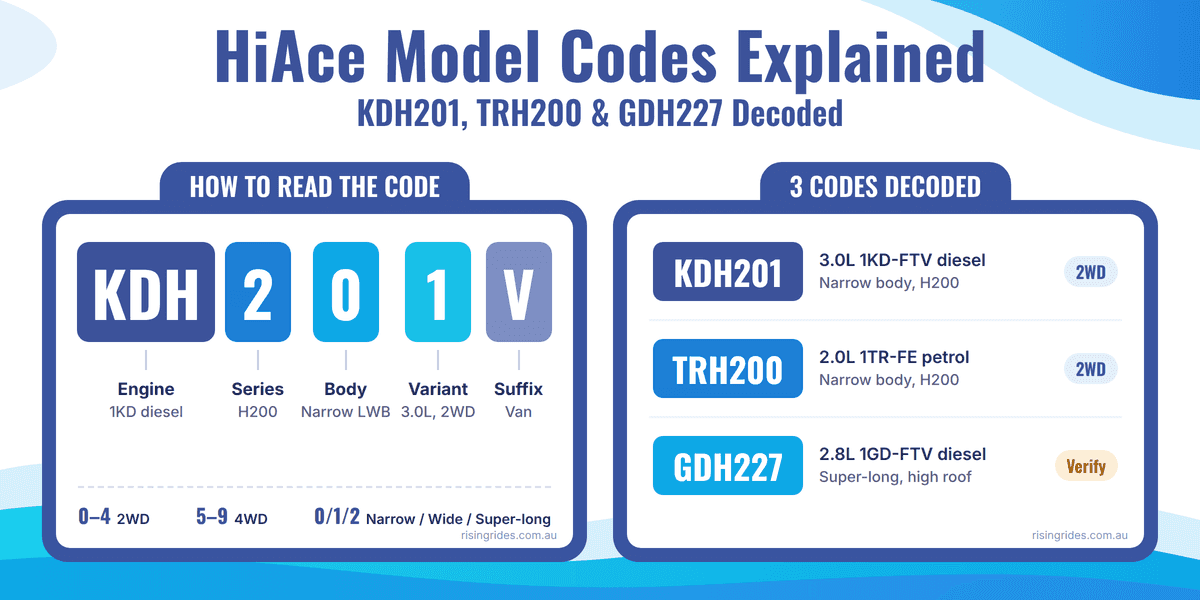
If you're trawling Japanese auction listings or local import ads for a HiAce, you've probably hit a wall of codes like KDH201, TRH200 and GDH227. The ad says "diesel 4WD high roof", the code says something else, and you can't tell which one to believe.
At Rising Rides, a boutique 4WD HiAce specialist in Lidcombe, Western Sydney, we read these codes every day. We buy directly from Japanese auctions including USS, TAA and HAA, and the model code is the first thing we check on every van, well before we read the seller's notes.
Here's the good news. The code is usually more trustworthy than the description, because it comes from Toyota, not from a salesperson. Once you know the pattern, you can read it in seconds.
This HiAce variant guide breaks down every segment of the JDM van model codes you'll meet in HiAce listings: the model series, the engine, the wheelbase and roof height, and 2WD versus 4WD. It shows how much you can confirm from the code alone, and exactly where you still need paperwork or photos before you trust a listing.
The quick answer
HiAce model codes such as KDH201, TRH200 and GDH227 have three parts.
- The letters are the engine family. KDH is the 2KD or 1KD diesel, TRH is the 1TR or 2TR petrol, and GDH is the 1GD diesel.
- The number is the series, body and drivetrain. The first digit is the generation (2 means H200). The second digit is the body (0 is narrow, 1 is wide, 2 is wide super-long). The last digit is the engine variant and drive, where 0 to 4 is generally 2WD and 5 to 9 is generally 4WD.
- The suffix letter is the registration category. V and K are vans, B is a bus (the Commuter), and W is a wagon.
From the code alone, you can reliably confirm the series, engine, body width, wheelbase and drivetrain. You can only partly confirm roof height. Always match the code against the auction sheet and frame number before you trust a seller's description.
Key takeaways
- The letters tell you the engine family, and the last digit narrows down the exact engine size.
- The first digit tells you the generation: H100, H200 or H300.
- The middle digit tells you the body width and wheelbase, and usually the roof height.
- On H200 HiAces, a last digit of 5 to 9 generally means 4WD, as in KDH206, GDH206 and TRH226.
- Transmission, seat count, grade and options are not encoded in the code. Check them separately.
- Importing a used HiAce into Australia falls under the Road Vehicle Standards Act 2018, so check eligibility before you bid.
What is a Toyota HiAce model code?
A HiAce model code is Toyota's factory shorthand for a vehicle's basic mechanical and body configuration. Japanese auction houses, exporters and parts catalogues all use it, because it is far more precise than a written description.
On Japanese paperwork, the code often appears with an emissions prefix in front of it, like this: ADF-KDH201V.
- ADF- (emissions prefix): the Japanese emissions certification category. It changed as emissions rules tightened, so it helps date the vehicle.
- KDH (engine family): the 2KD-FTV or 1KD-FTV diesel.
- 2 (model series): the H200 generation.
- 0 (body): narrow body, standard length.
- 1 (engine and drive variant): 3.0L 1KD-FTV, 2WD.
- V (suffix): registered as a van.
Other full-format examples you will see on auction sheets include CBF-TRH200V, LDF-KDH201V, QDF-GDH201V and, on recent models, 3DF-GDH201V. The prefix is useful for dating a van, but the part that describes the vehicle is everything after the dash.
Model code vs frame number
These two are often confused, but they do different jobs.
- The model code (for example KDH201V) describes a type of vehicle. Thousands of vans share the same code.
- The frame number (for example KDH201-0123456) identifies one individual vehicle. Japanese domestic vehicles use this short format instead of the 17-character VIN used on Australian-delivered cars.
The frame number on the auction sheet, the export certificate and the vehicle itself should always match. If they don't, stop and ask why.
Model code vs grade
The code describes the foundation of the van. It doesn't name the grade, such as DX, Super GL or Grand Cabin. It also doesn't confirm the transmission, the seat count, or options like dual sliding doors and a reversing camera.
On Japanese auction listings, a separate grade or type field often adds useful detail, such as "Long High Roof" or "Super GL". Read that field together with the code rather than instead of it.
Why the code matters before you compare prices
Two HiAces can look almost identical in photos and still be very different vans. A 3.0L diesel KDH201 and a 2.0L petrol TRH200 share the same narrow body, but they differ in performance, running costs and value. A 2WD van and a 4WD van of the same age can be thousands of dollars apart.
If you compare prices without checking the code, you can easily end up comparing the wrong things. The code also matters after you buy, because filters, brakes, driveline parts and some body panels differ by engine and body. Your mechanic and parts supplier will ask for it.
Where to find the model code on a HiAce
Don't rely on a badge, a sticker or the ad title. The model code and frame number should come from documents and from the vehicle itself.
- The Japanese auction sheet. The code usually appears in a dedicated model or chassis field near the top of the sheet, often with the emissions prefix.
- The export certificate. Japanese vehicles leave the country with an export deregistration certificate that records the frame number and model details.
- The stamped frame number. The frame number is stamped into the body or chassis. Ask the seller or agent for a clear photo of the stamping, not just a photo of a document.
- The manufacturer's plate. Toyota's identification plate records the model code, among other details. Its position varies, so ask the seller to photograph it.
All of these should agree. If the auction sheet says KDH206 and the stamped frame number starts with KDH201, you're looking at a 2WD van, whatever the ad says.
How production year changes the picture
The code stays the same across a long production run, but the van underneath it changes. The H200 was built from 2004 and received several facelifts in Japan, roughly in 2007, 2010, 2013 and 2017.
Here's the rough timeline for the Japanese market:
- 2004 to 2007: early diesel models used the 2.5L 2KD-FTV (KDH200, KDH205).
- 2007 onward: the 3.0L 1KD-FTV took over as the main diesel (KDH201, KDH206).
- 2010 and 2013 facelifts: styling, interior and equipment updates.
- 2017 onward: the 2.8L 1GD-FTV replaced the 1KD (GDH201, GDH206), paired with a 6-speed automatic.
This is why the build year matters as much as the code. A 2008 KDH206 and a 2016 KDH206 share the same engine and drivetrain, but they differ in styling, interior and equipment. Always check the build date on the auction sheet alongside the code, and don't assume a later model's features on an earlier van.
Reading HiAce model codes segment by segment
Every H200 HiAce code splits into five parts. Using KDH201V as the example: K D H, then 2, then 0, then 1, then V.
- Letters (KDH): the engine family.
- First digit (2): the model series, or generation.
- Second digit (0): the body size, which sets the wheelbase and usual roof height.
- Third digit (1): the engine variant and 2WD or 4WD.
- Suffix (V): the registration or body category.
Segment 1: Model series (the first digit)
The first digit of the number tells you which HiAce generation you're looking at.
- 1xx = H100: the older generation, built until 2004.
- 2xx = H200: built from 2004, and the most common Japanese import.
- 3xx = H300: the current generation, sold new in Australia since 2019 (for example GDH300 and GDH320).
KDH201, TRH200 and GDH227 all start with 2, so all three are H200-series vans. Toyota continued building the H200 for the Japanese market after the H300 arrived in Australia, which is why late-model H200s such as 2019 GDH206s turn up at Japanese auctions.
Segment 2: Engine (the letters, refined by the last digit)
KDH means diesel. It covers either the 2.5L 2KD-FTV or the 3.0L 1KD-FTV. The 2KD appears mainly on early Japanese models. The 1KD was used in Japan from about 2007 to 2017, and in most Australian-delivered H200 diesels.
TRH means petrol. It covers either the 2.0L 1TR-FE or the 2.7L 2TR-FE. The Japanese TRH200 is the 2.0L. The Australian LWB petrol van (TRH201) and the super-long and 4WD petrol models use the 2.7L.
GDH means the newer diesel. It is the 2.8L 1GD-FTV, used in Japanese H200s from 2017. It was never sold new in Australia in H200 form.
The letters tell you the fuel and engine family. Where a family has two engines, the last digit tells you which one. KDH200 is the 2.5L diesel, while KDH201 is the 3.0L diesel.
The GDH point matters for Australian buyers. Australia went straight from the KDH-powered H200 to the new H300 in 2019. So any GDH201 or GDH206 you find here is a Japanese import, not a local-delivered vehicle.
Segment 3: Wheelbase and roof height (the second digit)
The middle digit tells you the body, and the body sets the wheelbase and the usual roof height.
- 0 (20x codes): narrow body, standard length. Called "LWB" in Australia. The wheelbase is about 2,570 mm. With a standard roof, the van is about 4,695 mm long, 1,695 mm wide and 1,980 mm high. High-roof versions also exist, at about 2,240 mm high.
- 1 (21x codes): wide body, standard length. The wheelbase is about 2,570 mm. The van is about 4,840 mm long, 1,880 mm wide and 2,105 mm high, usually with a mid roof.
- 2 (22x codes): wide body, super-long. Called "SLWB" in Australia. The wheelbase is about 3,110 mm. The van is about 5,380 mm long, 1,880 mm wide and 2,285 mm high, with a high roof.
These figures are approximate and vary by year, grade and drivetrain. 4WD versions often sit a little higher than 2WD versions.
How reliable is this from the code alone?
- Wheelbase: high confidence. A 20x or 21x is the shorter wheelbase, and a 22x is the long one.
- Width: high confidence. A 20x is narrow, while 21x and 22x are wide.
- Roof height: partly confirmed. A 22x is a high roof, and a 21x is normally a mid roof. A 20x can be a standard roof or a high roof, so check the height figure on the auction sheet.
One more point: the number is a series identifier, not a measurement. Don't read "200" or "220" as a length. The narrow 20x and wide 21x share roughly the same wheelbase, and only the 22x has a significantly longer one.
Rising Rides tip: In our experience, the K suffix often shows up on narrow-body high-roof vans, such as the KDH206K and GDH206K LWB high-roof 4WDs we regularly source. It's a useful clue, but still confirm the height on the auction sheet.
Segment 4: 2WD vs 4WD (the last digit)
- A last digit of 0 to 4 usually means 2WD. Examples: TRH200, KDH201, GDH201 and KDH221.
- A last digit of 5 to 9 usually means 4WD. Examples: KDH205, KDH206, GDH206 and TRH226.
This is one of the most useful checks you can make from the code alone. If an ad says "4WD" but the code ends in 0 to 4, the ad is very likely wrong.
Segment 5: The suffix (V, K, B, W, R)
- V: van, with a commercial, goods-carrying registration.
- K: a commercial van designation. On narrow-body vans it typically marks the high-roof version (for example KDH205K, KDH206K and GDH206K), while V marks the standard-roof van. K also appears on wide and super-long vans, such as the GDH211K and TRH221K.
- B: bus, meaning the Commuter microbus.
- W: wagon, a passenger vehicle such as the Wagon or Grand Cabin.
- R: seen on export and Australian-delivered codes (for example KDH201R), followed by a longer grade code.
The suffix tells you the registration category, not the grade. If a seller drops it, ask for the full code. KDH201V tells you more than KDH201 on its own.
Wheelbase, overall length and cargo floor: three different measurements
Buyers often treat these three numbers as one. They aren't, and mixing them up is how people end up with a van that doesn't fit their garage, their bed build or their load.
Wheelbase is the distance between the front and rear axle centres. It affects the turning circle, ride comfort and stability.
Overall length is the distance from bumper to bumper. It decides whether the van fits your garage, car space or ferry booking.
Cargo-floor length is the usable floor behind the front seats or bulkhead. It decides what you can carry and how long a bed you can fit.
The model code tells you the wheelbase and body length with good confidence. It can't tell you the usable cargo floor, because that depends on the seating layout. A van with a rear bench seat, or a factory camper fit-out, will have much less open floor than a bare panel van with the same code.
If you're planning a camper conversion, measure the cargo floor yourself or ask the seller for a tape-measure photo. Don't estimate it from the overall length.
Spotting roof height in auction photos
For narrow-body 20x vans, where the code can't settle the roof question, photos are your best tool.
- Look at the side profile. A standard-roof van has a roofline that sits close to the top of the doors. A high-roof van has a clearly taller body above the door line.
- Look at the sliding door. On a high-roof van, the sliding door opening is noticeably taller relative to the side windows.
- Look inside. Interior photos taken from the rear doors show headroom clearly. A high roof leaves obvious space above the seat backs.
- Check the height figure. A standard-roof narrow van is roughly 1,980 mm tall. A figure of around 2,240 mm points to a narrow high-roof van.
Roof racks, pop-tops and aftermarket roof conversions can make a van look taller in photos. If the photo and the height figure disagree, ask why.
HiAce variant guide: commonly seen H200 codes
These are the H200 codes Australian buyers see most often, in Japanese auctions and on local-delivered vans.
Narrow body, 2WD
- TRH200: 2.0L 1TR-FE petrol
- TRH201: 2.7L 2TR-FE petrol (the Australian LWB)
- KDH200: 2.5L 2KD-FTV diesel
- KDH201: 3.0L 1KD-FTV diesel (the Australian LWB)
- GDH201: 2.8L 1GD-FTV diesel
Narrow body, 4WD
- KDH205: 2.5L 2KD-FTV diesel
- KDH206: 3.0L 1KD-FTV diesel
- GDH206: 2.8L 1GD-FTV diesel
Wide body, standard length
- GDH211: 2.8L 1GD-FTV diesel, 2WD, mid roof (often seen as GDH211K)
Super-long body
- TRH221 and KDH221: 2WD high-roof van (the Australian SLWB), with the 2.7L petrol or 3.0L diesel
- TRH223 and KDH223: 2WD Commuter, with the 2.7L petrol or 3.0L diesel
- TRH226: 4WD high roof, with the 2.7L petrol
Toyota used many more codes across Japanese grades and years, including wide-body wagons and 4WD Commuters. Treat this list as a guide, and confirm any code against the auction sheet or Toyota parts data.
Which HiAce code suits which buyer?
Once you can read the codes, the next question is which one fits the way you'll use the van. Here's a practical starting point.
- Tradie or courier working mostly in town: look at the KDH201 or TRH201. A 2WD narrow body is easy to park, simple and proven.
- Light-duty user on a tighter budget: look at the TRH200. The 2.0L petrol and 2WD keep the price down, but there's less power for heavy loads.
- Tourer who wants 4WD without a huge footprint: look at the KDH206 or GDH206. The narrow LWB body with 4WD fits most car spaces and many garages.
- Building a camper with a full bed and storage: look at the TRH226 and super-long 4WD diesel versions. The super-long high-roof body gives the most interior length and headroom.
- Carrying big loads or many passengers on sealed roads: look at the KDH221, TRH221, KDH223 or TRH223. The 2WD super-long body comes in van or Commuter layouts.
A few trade-offs are worth weighing.
- Diesel or petrol. The 1KD and 1GD diesels offer strong low-down torque, which helps with loaded touring and hills. The 2TR petrol is simpler, avoids diesel particulate filter concerns, and suits buyers who do more short trips.
- Narrow or super-long. A narrow LWB is easier to live with day to day. A super-long body gives you far more room but needs more space to park and turn.
- 2WD or 4WD. 4WD adds traction on gravel, sand, snow and wet grass at campsites. It also adds weight, complexity and usually cost. If you'll stay on sealed roads, a 2WD may be all you need.
If you're unsure, start with how and where you'll use the van most weeks, not the one big trip you're planning.
Decoding KDH201, TRH200 and GDH227 from the code alone
KDH201
- KDH → diesel, from the 2KD or 1KD family
- 2 → H200 series
- 0 → narrow body, about 2,570 mm wheelbase, usually a standard roof
- 1 → 3.0L 1KD-FTV, 2WD
From the code alone: an H200 with a 3.0L diesel, narrow body, shorter wheelbase and 2WD. In Australia, this is the familiar diesel LWB HiAce van that tradies and couriers have used for years.
Still to confirm: roof height, transmission, seat count and grade. A KDH201 can be a bare three-seat panel van or a well-optioned Super GL with a rear seat.
Red flag: an ad calling a KDH201 "4WD" or "2.5 diesel". The 1 at the end means 3.0L and 2WD.
TRH200
- TRH → petrol, from the 1TR or 2TR family
- 2 → H200 series
- 0 → narrow body, about 2,570 mm wheelbase, usually a standard roof
- 0 → 2.0L 1TR-FE, 2WD
From the code alone: an H200 with a 2.0L petrol engine, narrow body, shorter wheelbase and 2WD.
Still to confirm: roof height, transmission, seat count and grade.
Red flag: an ad claiming "2.7 petrol" on a TRH200, or listing diesel specifications on any TRH code. The 2.7L narrow-body petrol van sold new in Australia is the TRH201, not the TRH200. Many guides get this wrong, and the difference matters if you plan to carry heavy loads or tow.
GDH227
- GDH → diesel, the 2.8L 1GD-FTV
- 2 → H200 series
- 2 → wide super-long body, about 3,110 mm wheelbase, high roof
- 7 → by the pattern, a 4WD variant
From the code alone, if genuine: an H200 with a 2.8L diesel, super-long high-roof body and 4WD.
Caution: GDH227 isn't among the commonly documented 1GD H200 codes. The well-known ones are GDH201, GDH206, GDH211 and GDH223. Following the pattern of the TRH226 super-long 4WD petrol van, the listing may actually refer to a different code. A code that doesn't fit the known list is a signal to slow down and ask for proof.
Before you go any further with a GDH227 listing, ask for:
- The auction sheet and a clear photo of the stamped frame number.
- Confirmation that the length (about 5,380 mm) and height (about 2,285 mm) match a super-long body.
- Underbody photos showing a front differential, front driveshaft and transfer case.
If the seller can't provide these, treat the listing as unverified.
Real examples from the Rising Rides yard
Theory is useful, but real vans make it click. Here's how we decode three codes we see regularly on our own 4WD HiAce stock.
KDH206K: the letters mean a 3.0L 1KD diesel, the 2 means H200, the 0 means a narrow LWB body, and the 6 means 4WD. With the K suffix, it's often a high-roof van.
GDH206K: the letters mean a 2.8L 1GD diesel, the 2 means H200, the 0 means a narrow LWB body, and the 6 means 4WD. It's a later-model diesel 4WD, and our recent examples are high-roof vans.
TRH226K: the letters mean a 2.7L 2TR petrol, the 2 means H200, the second 2 means a wide super-long SLWB body, and the 6 means 4WD. It's a petrol 4WD high roof, and a popular base for campervans.
Notice how the same logic works every time. The letters give the engine, the 2 confirms H200, the middle digit gives the body, and the 6 confirms 4WD. You can check any listing the same way.
The KDH206 and GDH206 are the go-to choices for buyers who want a diesel 4WD van with a manageable footprint. The TRH226 suits buyers who need the extra length of the super-long body, especially for a camper build with a proper bed and storage.
You can see how these codes appear in real listings on the Rising Rides stock list, and compare each van's code against its description.
How to read a Japanese auction sheet
The auction sheet is the single most useful document for confirming what a code means on a specific van. It's written by an independent inspector at the auction house, not by the seller. Layouts vary between auction houses such as USS, TAA and HAA, but most sheets cover the same ground.
What to look for first
- Model code and frame number. Check these match the listing and the export documents.
- Year and grade. The build year and grade (for example Super GL or DX) tell you which version of the code you're looking at.
- Engine size and fuel. A quick cross-check against the letters in the code.
- Transmission and drive. Look for AT or MT, and a 4WD marking where it applies.
- Mileage. Recorded in kilometres. Some sheets flag suspected odometer issues.
- Dimensions. Where shown, length, width and height confirm the body and roof.
Auction grades
Most sheets give an overall grade and a separate interior grade.
- 5 or S: very close to new, and rare on used commercial vans.
- 4.5: excellent condition for its age.
- 4: good condition with minor wear.
- 3.5: average, with visible wear or small marks.
- 3 or lower: heavier wear, damage or issues to look into.
- R or RA: repaired, meaning accident or structural repair history.
Interior grades are usually letters, with A being the best and lower letters showing more wear. Grading standards differ slightly between auction houses, so read the inspector's notes as well as the number.
Damage map letters
The outline drawing of the van uses letter and number codes to mark damage. The letter shows the type, and the number shows the severity, usually from 1 (minor) to 3 (major).
The most common codes are A for a scratch, U for a dent, B for a dent with a scratch, W for a wave or repaired panel, S for rust, C for corrosion, Y for a crack or hole, X for a panel that needs replacing, and XX for a panel that has already been replaced.
So "U2" on a sliding door means a noticeable dent, while "S3" on a sill means serious rust. Codes can vary slightly between auction houses, so ask your agent or dealer to translate any handwritten notes.
Rising Rides tip: Don't stop at the grade. The inspector's handwritten notes often mention things the number alone won't show, like underbody rust or aftermarket parts, so get them translated before you bid.
How to confirm the exact configuration from the code alone
Before you read the seller's description, decode the code and write down what it tells you. Then compare the ad against your notes.
- Split the code into the letters, the three digits and the suffix.
- Series: does it start with 2 (H200) or 3 (H300)? Does that fit the year in the ad?
- Engine: do the letters match the fuel in the ad? Does the last digit match the claimed engine size?
- Body: does the second digit (0, 1 or 2) match the ad's LWB or SLWB, narrow or wide claim?
- Drivetrain: does the last digit (0 to 4 or 5 to 9) match the ad's 2WD or 4WD claim?
- Roof: for a 20x code, check the height figure before believing "high roof".
Here are the mismatches we see most often, and what to do about each one:
- The ad says "4WD", but the code ends in 0 to 4 (for example KDH201). Treat it as 2WD until proven otherwise, and ask for underbody photos.
- The ad says "diesel", but the code starts with TRH. It is petrol. Clarify with the seller.
- The ad says "2.7 petrol" on a TRH200. The TRH200 is the 2.0L. Check the engine on the auction sheet.
- The ad says "SLWB" or "super long", but the second digit is 0. It is a standard-length body. Check the length figure.
- The ad says "high roof" on a 20x code with a height of about 1,980 mm. It is a standard roof.
- The code isn't in common reference lists. Ask for the auction sheet and a frame number photo before going further.
If the code and the description agree, move on to condition, history and eligibility. If they don't, trust the code and the documents over the ad text.
How to confirm 2WD vs 4WD properly
The drivetrain is the single most common thing sellers get wrong, and it has the biggest effect on price. Work through these checks in order.
- Check the full model code. On H200s, a last digit of 5 to 9 generally indicates 4WD.
- Read the auction sheet's drive field. Japanese auction sheets usually mark 4WD clearly. If it's blank or unclear, ask before bidding.
- Look underneath. A genuine 4WD HiAce has a front differential, a front driveshaft and a transfer case. Ask your agent or the seller for clear underbody photos.
- Ignore cosmetic clues. "4WD style", lift kits, roof racks and chunky all-terrain tyres prove nothing. A 2WD van with a lift kit is still a 2WD van.
- Confirm on inspection. A qualified mechanic can confirm that the 4WD system engages and works as it should.
Importing a HiAce into Australia: check eligibility first
Since the Road Vehicle Standards Act 2018 (RVSA) fully commenced on 1 July 2021, importing a used vehicle into Australia requires an import approval. Most used vehicles can't be imported simply because they're popular or well priced in Japan.
The common pathways include:
- Specialist and Enthusiast Vehicle Scheme (SEVS). The specific model and variant must be on the Register of Specialist and Enthusiast Vehicles, and it must be modified and complied by a Registered Automotive Workshop.
- The 25-year concession. Vehicles manufactured more than 25 years ago face fewer requirements. The H200 HiAce began production in 2004, so it does not generally qualify under this pathway yet.
Under the RVSA, newly complied vehicles are entered on the Register of Approved Vehicles (RAV) instead of receiving the old-style compliance plate.
If you're importing privately, check current eligibility with the federal Department of Infrastructure, Transport, Regional Development, Communications and the Arts before you pay a deposit or bid. Rules and register entries change. For many buyers, the simpler route is purchasing a van that's already in Australia, registered and prepared by a licensed dealer.
JDM van model codes vs Australian-delivered HiAce codes
Japanese-market (JDM) HiAces often carry codes you'll never see on a local Toyota dealer's paperwork. That's because Japan had a much wider H200 range than Australia.
- Body choices. Japan had narrow, wide and super-long bodies in several roof heights. Australia mainly got the narrow LWB and the super-long SLWB.
- 4WD. Widely available in Japan (for example KDH206, GDH206 and TRH226), but not offered on the Australian H200.
- Engines. Japan had 2.0 and 2.7 petrol engines, plus 2.5, 3.0 and later 2.8 diesels. Australia had the 2.7 petrol and 3.0 diesel, plus a 2.5 diesel in early vans (KDH200, about 2005 to 2007).
- Passenger versions. Japan offered the Wagon, Grand Cabin and Commuter. Australia offered the Commuter.
- Code format. Japanese codes use suffixes such as V, K, B and W. Australian codes often end in R, followed by a grade code.
There are also practical differences to plan for.
- Audio and navigation. Japanese head units are set up for Japan's FM band and Japanese-language menus, so many owners replace them. This is why Rising Rides fits an Apple CarPlay and Android Auto head unit to every vehicle.
- Equipment and options. Japanese grades can include features such as power sliding doors or specific interior layouts that differ from Australian specs.
- Seating and registration. The seat count and registration category in Japan may not match how the van will be registered in your state. Check this before you rely on a particular seating layout.
- Parts. Many mechanical parts are shared with Australian models, especially on 1KD and 2TR vans. JDM-only parts, such as 4WD driveline and some body or trim items, may take longer to source.
What to ask your agent or exporter before bidding
If you're buying through an auction agent, these questions will save you from most unpleasant surprises.
- What is the full model code, including the suffix, and what is the frame number?
- Can you send a clear photo of the stamped frame number and the manufacturer's plate?
- Can you provide the full auction sheet, with the handwritten notes translated?
- Is it 2WD or 4WD, and can you send underbody photos showing the front differential and transfer case?
- What are the length, width and height figures?
- Is this exact model and variant eligible for import into Australia under current rules?
- What will the total landed cost be, including shipping, compliance, registration and taxes?
A good agent will answer all of these without hesitation. If the answers are vague, walk away. There will always be another van.
Step by step: verifying a HiAce listing before you pay
- Get the full model code with suffix, and the full frame number.
- Match the documents. The auction sheet, export certificate and physical frame number must agree.
- Check each specification separately, using the checklist below.
- Use photos properly. Count doors, windows and seats. Look for rust in sills and floors, heavy cargo wear and signs of accident repair.
- Run a PPSR check to confirm there's no finance owing and no written-off record.
- Check registration and insurance for the exact code and body type. A van, a bus and a wagon can be treated differently.
- Get an independent inspection if you're not buying from a dealer that provides one.
- Record the verified specification. Keep the confirmed code, frame number and specs for insurance, servicing and resale.
Your verification checklist:
- Engine and fuel (high priority): check the model code, the auction sheet and engine bay photos.
- Body size and roof (high priority): check the model code, the auction sheet dimensions and photos.
- Drivetrain, 2WD or 4WD (critical): check the model code, the auction sheet and underbody photos.
- Transmission (high priority): check the auction sheet and interior photos.
- Seating and body type (high priority): check the suffix, photos and registration papers.
- Condition and history (critical): check the auction grade, an inspection report and a PPSR search.
Common mistakes to avoid
- Assuming every KDH is a 2.5 diesel, or every TRH is a 2.7 petrol.
- Treating "200" or "220" as a length measurement.
- Believing "4WD" in an ad title without checking the last digit and the hardware.
- Assuming every narrow-body 20x van has a standard roof.
- Comparing prices without matching the engine, body and drivetrain.
- Paying a deposit on a private import before confirming it's eligible.
Buying a 4WD HiAce from Rising Rides
Decoding the code is step one. Step two is buying from someone who has already done the checking for you.
Rising Rides is a boutique used vehicle dealership in Lidcombe, Western Sydney, specialising in imported Japanese 4WD HiAce vans, campervans and motorhomes. We source directly from established Japanese auctions including USS, TAA and HAA. Every vehicle goes through the same handover standard before it reaches you:
- NSW Roadworthy Certificate: every vehicle is independently inspected before it leaves us.
- Clear PPSR: no hidden finance and no write-offs.
- Oil and fluid check before every handover.
- Apple CarPlay and Android Auto head unit and reverse camera fitted as standard.
- AWN-backed warranty cover with Australia-wide support.
- Deep detail and presentation inside and out.
- Upgraded solar packages available on our campervan range.
We also offer finance, a trade-in program and delivery Australia-wide.
Not sure what a code in a listing means? Send it to us and we'll help you decode it.
Contact Rising Rides Global Pty Ltd, 16A Adderley Street East, Lidcombe NSW 2141. Phone and WhatsApp: 0478 901 002. Email: info@risingrides.com.au. Hours: Monday to Saturday 8:30 am to 6:30 pm, Sunday by appointment. Motor Dealer Licence MD095543 · ABN 72 673 411 857
Browse 4WD HiAce stock · 4WD HiAce campervans · Contact us
Frequently asked questions
What do Toyota HiAce model codes mean?
They are factory codes describing the engine family, generation, body size and drivetrain. In KDH201V, KDH is the diesel engine family, 2 is the H200 generation, 0 is the narrow body, 1 is the 3.0L 2WD variant, and V means van.
What do KDH201, TRH200 and GDH227 mean?
KDH201 is an H200 HiAce with the 3.0L 1KD-FTV diesel, a narrow body and 2WD. TRH200 is an H200 with the 2.0L 1TR-FE petrol engine, a narrow body and 2WD. GDH227 would read as a 2.8L 1GD-FTV diesel, super-long high-roof body and 4WD, but it isn't a commonly documented code, so verify it with the auction sheet.
What are JDM van model codes?
JDM van model codes are the factory codes Toyota uses on Japanese domestic market vans such as the HiAce. They appear on Japanese auction sheets and export papers, and they describe the engine, generation, body and drivetrain. Japan had many more HiAce variants than Australia, so JDM codes cover combinations never sold here, such as 4WD H200 vans.
Can I confirm a HiAce's configuration from the model code alone?
Mostly. The code reliably shows the model series, engine, body width, wheelbase and 2WD or 4WD. It only partly shows roof height: 22x codes are high roof, but narrow-body 20x codes can be standard or high roof, so check the auction sheet height.
What is the difference between KDH, TRH and GDH?
KDH is diesel, either the 2.5L 2KD-FTV or the 3.0L 1KD-FTV. TRH is petrol, either the 2.0L 1TR-FE or the 2.7L 2TR-FE. GDH is the 2.8L 1GD-FTV diesel used in Japanese H200s from 2017.
What does the first number in a HiAce code mean?
It is the generation. Codes in the 100s are H100, the 200s are H200 (2004 onward), and the 300s are H300. KDH201, TRH200 and GDH227 are all H200-series codes.
Is the KDH201 a 2.5 or a 3.0 diesel?
The KDH201 uses the 3.0L 1KD-FTV diesel. The 2.5L 2KD-FTV version is the KDH200.
What engine is in a TRH200?
The Japanese-market TRH200 uses the 2.0L 1TR-FE petrol engine. The Australian-delivered LWB petrol HiAce is the TRH201, which has the 2.7L 2TR-FE.
How can I tell if a HiAce is 4WD from the code?
On H200 HiAces, a last digit of 5 to 9 generally means 4WD, as in KDH206, GDH206 and TRH226. A last digit of 0 to 4, as in KDH201 and TRH200, generally means 2WD. Confirm with the auction sheet and underbody photos.
What does the K suffix mean on a HiAce?
K is a commercial van designation. On narrow-body vans it typically marks the high-roof version, such as the KDH205K, KDH206K and GDH206K, and it also appears on wide and super-long vans such as the GDH211K and TRH221K, but confirm the roof height using the auction sheet's height figure.
Is GDH227 a real HiAce code?
It isn't among the commonly documented 1GD H200 codes, which include GDH201, GDH206, GDH211 and GDH223. If you see GDH227 in a listing, ask for the auction sheet and a frame number photo to confirm the actual code.
What should I do if the seller's description doesn't match the code?
Trust the code and the documents over the ad. Ask for the auction sheet, a frame number photo, and underbody photos if 4WD is claimed.
Can I import any Japanese HiAce into Australia?
No. Under the Road Vehicle Standards Act 2018, you need an import approval, and most used H200 HiAces must be eligible through a pathway such as SEVS. Check current eligibility with the federal Department of Infrastructure, or buy from a licensed dealer with vehicles already in Australia.
Where can I buy a 4WD HiAce in Sydney?
Rising Rides in Lidcombe, Western Sydney, specialises in imported Japanese 4WD HiAce vans and campervans, including KDH206, GDH206 and TRH226 models. Every van comes with a NSW roadworthy certificate, a clear PPSR and warranty cover.
Where is the model code on a HiAce?
Check the Japanese auction sheet, the export certificate, the stamped frame number and Toyota's manufacturer's plate. All of them should show the same code and frame number. Ask the seller for photos of the stamping and the plate rather than relying on a badge or the ad title.
Does the production year change what a code means?
The code's basic meaning stays the same, but the equipment changes. For example, KDH diesels moved from the 2.5L 2KD to the 3.0L 1KD around 2007, and Japanese H200s switched to the 2.8L 1GD with a 6-speed automatic from 2017.
What does R or RA mean on a Japanese auction sheet?
R or RA means the vehicle has repair history, usually accident or structural repair. It doesn't automatically rule a van out, but it needs a closer inspection and should be reflected in the price.
Which HiAce code is best for a camper conversion?
For the most interior room, a super-long high-roof body such as the TRH226 (4WD petrol) is popular. For a smaller footprint with 4WD, the KDH206 and GDH206 narrow LWB vans are common choices, especially in high-roof form.
Is a JDM HiAce the same as an Australian-delivered one?
Not always. Japan had wider body choices, 4WD versions and different engines. JDM vans can also differ in audio, options and seating, so check the exact specification rather than assuming it matches an Australian model.
Conclusion
HiAce model codes like KDH201, TRH200 and GDH227 look confusing at first, but they follow a clear pattern. The letters give you the engine, the first digit the series, the middle digit the body and wheelbase, and the last digit the drivetrain. Decode the code before you read the ad, and you'll spot most misleading listings in under a minute.
The code is your first filter, not the final word. Match it against the auction sheet and frame number, confirm the roof height and 4WD hardware, and check eligibility and history before you commit. If you'd rather skip the guesswork, the Rising Rides team is happy to help.
Disclaimer: Model codes, dimensions and import rules can vary by year, grade and market. Always confirm details with official Toyota data, the auction sheet and the relevant Australian authorities.