
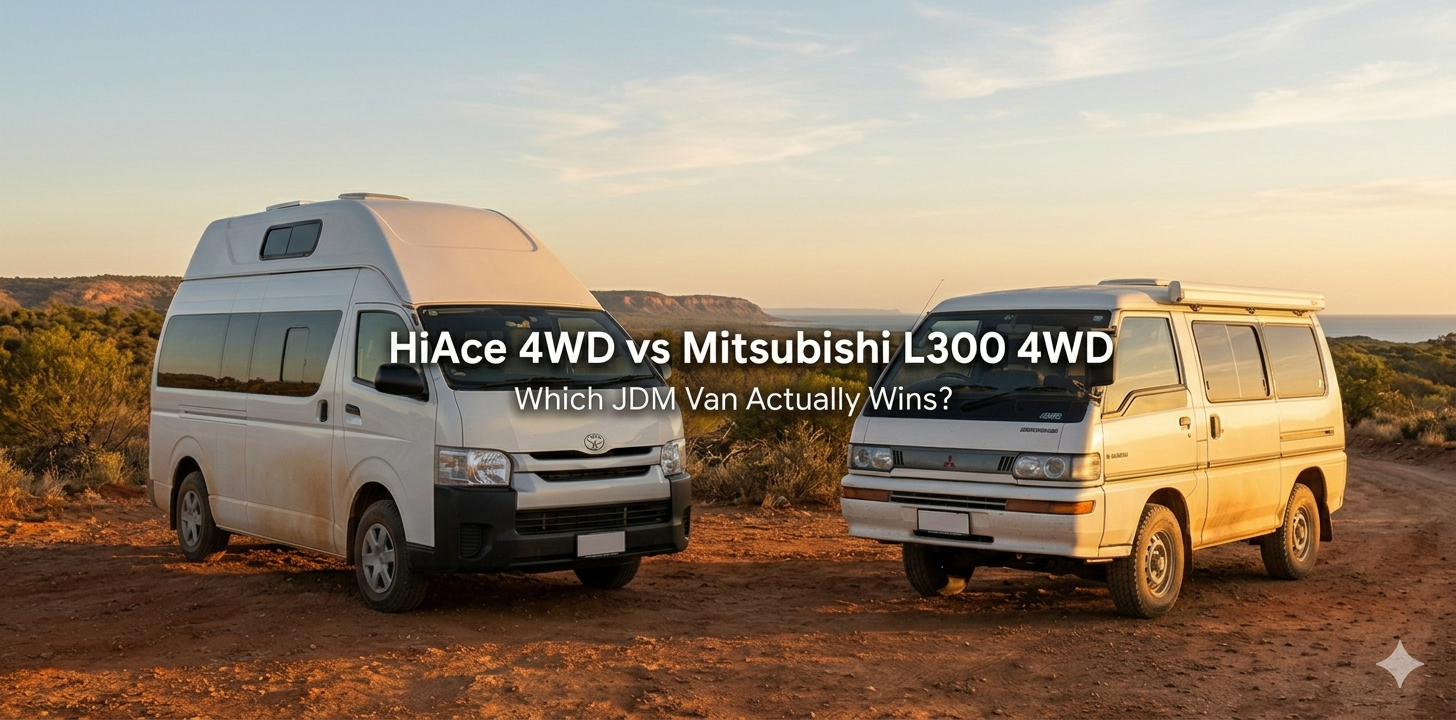
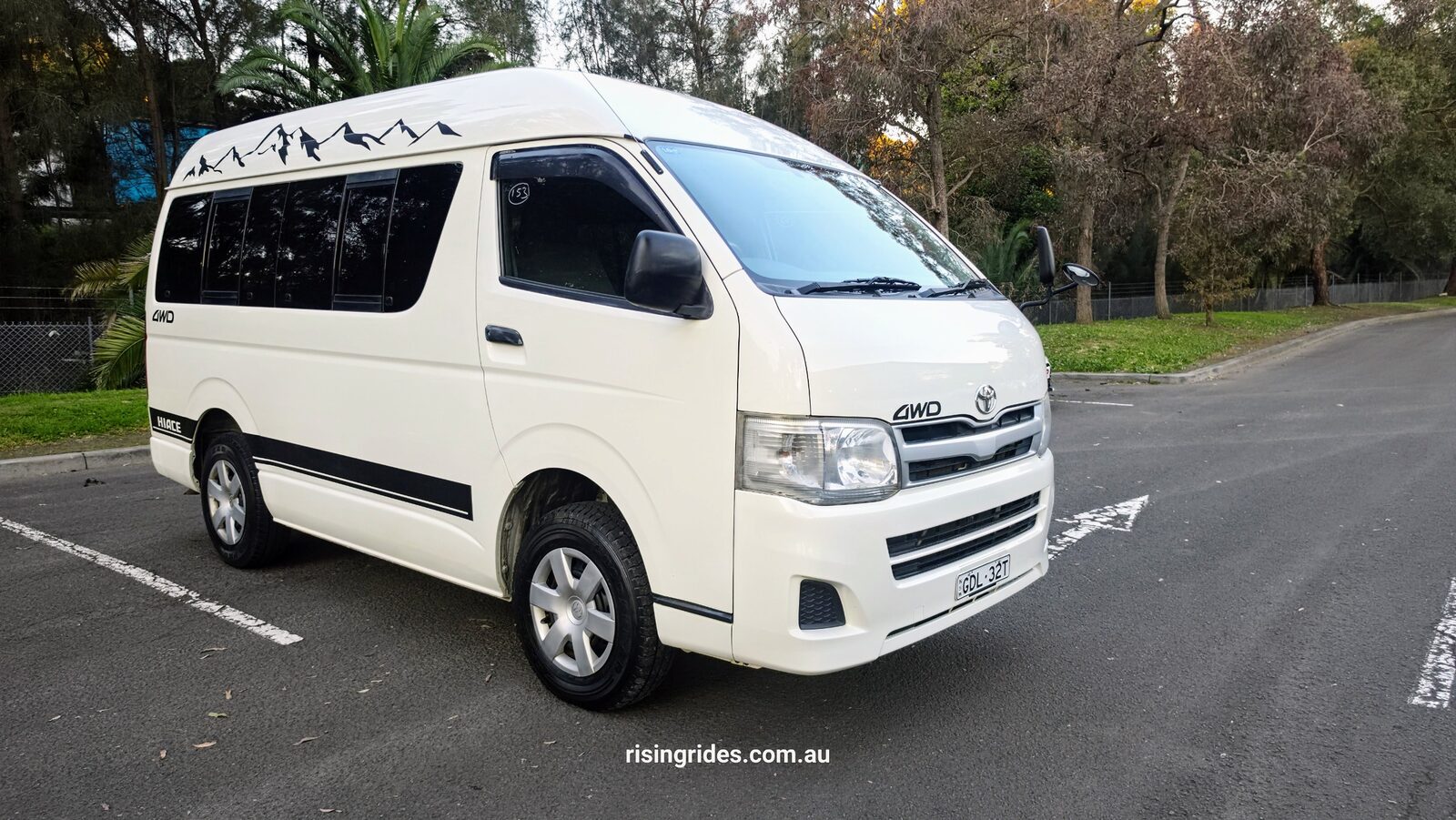
If you've spent any time on Australian 4WD forums or van-life Facebook groups, you already know this debate. The Hiace 4WD and the Mitsubishi L300 4WD are two of the most sought-after JDM imports in the country — and for good reason. Both are compact, capable, diesel-powered vans from Japan that never made it to Australian showrooms new. Both have cult followings. And both can take you places a standard transit van would never survive.
So which one should you buy? The honest answer is: it depends on what you're planning to do with it. But by the end of this comparison, you'll know exactly which one suits your situation — and why.
Quick Specs at a Glance

Toyota Hiace 4WD
- Production years: 1982–2019 (4WD variants)
- Engine options: 1KZ-TE, 5L-E, 1KD-FTV diesel; 2RZ/3RZ petrol
- Drivetrain: Part-time 4WD with low range
- Body styles: Van, Wagon, Super Long, Grand Cabin
- Payload (approx): Up to 1,500 kg GVM depending on variant
- Fuel economy: 9–12 L/100km (diesel)
- Typical AU landed price: $35,000–$75,000+
- Parts availability (AU): Good to excellent
Mitsubishi L300 4WD
- Production years: 1986–2006
- Engine options: 4D56 diesel; G63B/4G63 petrol
- Drivetrain: Part-time 4WD with low range
- Body styles: Van, Wagon, Delica Star Wagon
- Payload (approx): Up to 1,250 kg GVM
- Fuel economy: 10–14 L/100km (diesel)
- Typical AU landed price: $18,000–$45,000
- Parts availability (AU): Moderate — improving
Engine and Reliability: Toyota’s Edge Is Real
This is where the Hiace 4WD builds its reputation and, frankly, where it's hardest to argue against.
The most common Hiace 4WD diesel is the 1KZ-TE (3.0L turbo diesel) in H100-era models, followed by the 1KD-FTV (3.0L D-4D common-rail diesel) in later H200 models. Both engines are proven in some of the harshest working environments on earth — Australian outback mining fleets, Southeast Asian rural routes, and Japanese snowfields. The 1KD in particular is a modern, refined unit that responds well to servicing and holds up under sustained highway loads.
The Mitsubishi L300 runs the 4D56 — a 2.5L turbo diesel also found in Pajeros, Delicas, and thousands of Triton utes. It's a solid engine, well understood by mechanics, and genuinely long-lived when maintained. The catch: it's an older, simpler design that can be thirstier and less refined than the later Hiace diesels. Head gasket failures are a known issue on high-km examples, particularly if the engine has ever overheated.
Verdict
Toyota Hiace 4WD. The 1KD-FTV is a more modern, refined engine. The 4D56 in the L300 is solid but older, and head gasket issues on neglected examples are a real risk. A pre-purchase inspection is essential on both vehicles.
Off-Road Capability: More Equal Than You’d Think
Both vans run a part-time 4WD system with a proper low-range transfer case — not a soft AWD setup. That means both are genuine off-roaders when you need them to be. Neither is a rock crawler, but both will handle corrugated dirt roads, beach driving, and moderate tracks without drama.
Where the L300 has an advantage
The Mitsubishi L300 — especially the short-wheelbase Delica variants — has a shorter turning circle and a lower centre of gravity relative to its body size. On tight bush tracks where you're threading between trees, a short-body L300 is noticeably more nimble than a long-wheelbase Hiace Super Long.
Where the Hiace wins
The Hiace 4WD offers more variant diversity. You can choose a standard wheelbase for tight tracks or a Super Long for living space. Ground clearance on standard 4WD models is acceptable, and aftermarket lift kits and larger tyre fitments are available and well-documented — something the L300 community is still catching up on.
Verdict
Roughly even, with the edge going to each vehicle depending on use. L300 is better on tight tracks in a short-body configuration. Hiace wins on variant flexibility and aftermarket support for those who want to modify.
Interior Space and Camper Potential: Hiace Dominates
This is the biggest practical difference between the two, and it's not close.
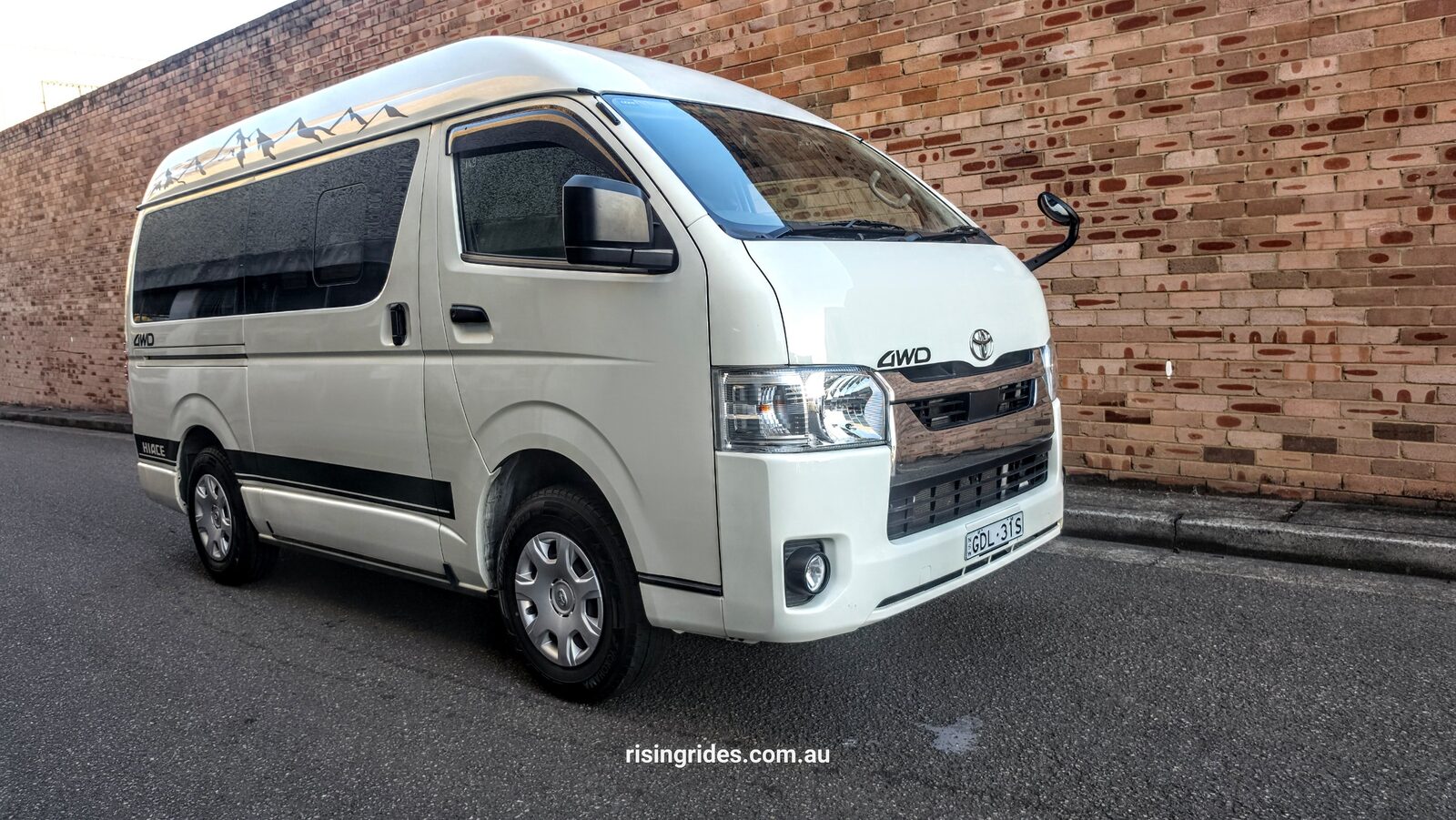
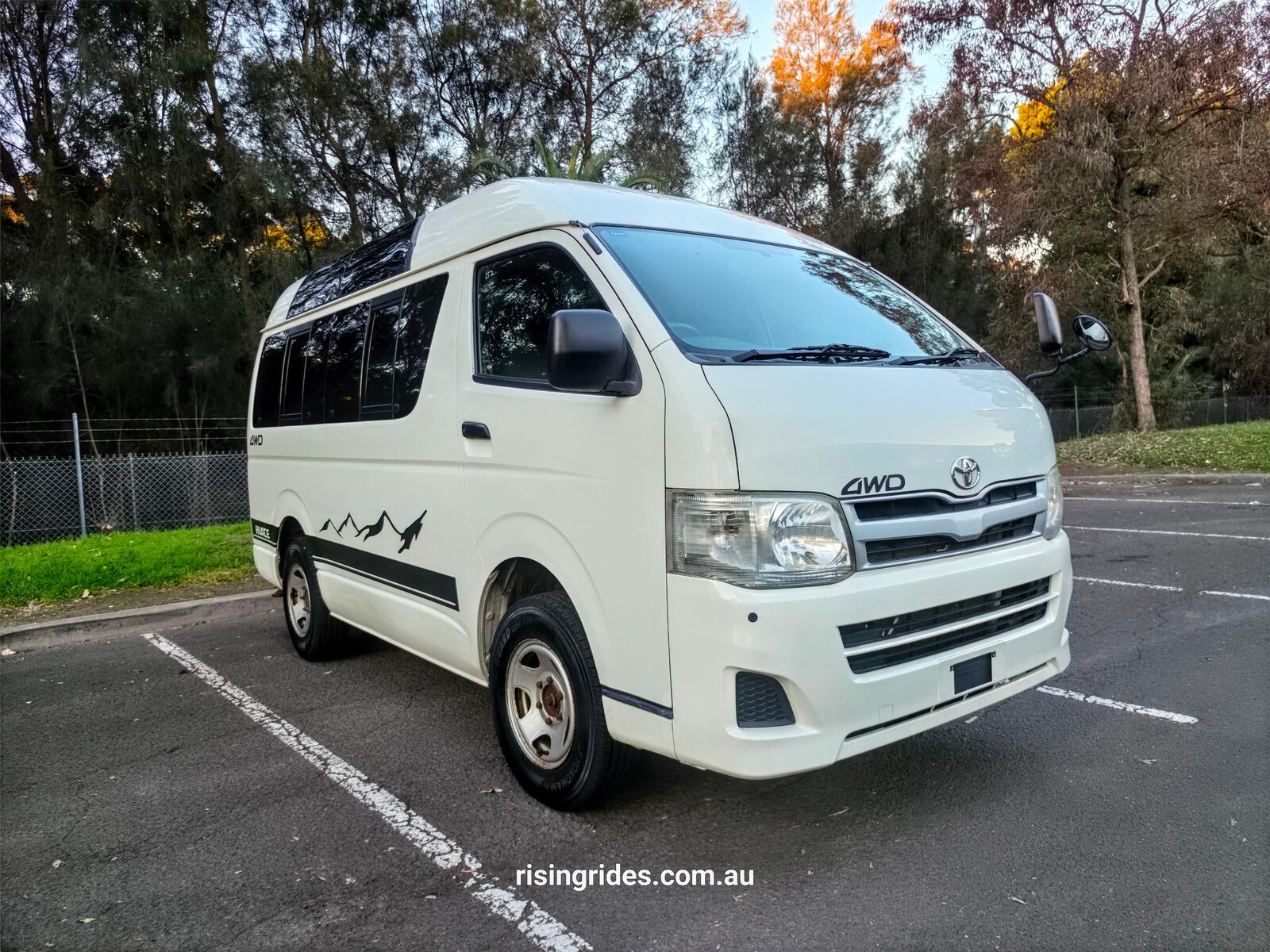
The Toyota Hiace 4WD — particularly the Grand Cabin and Super Long variants — offers a standing-height interior, genuine 8-seater configurations, and a floor plan that conversion builders have worked with for decades. If you're planning a camper build, a tradie fit-out, or a family touring rig, the Hiace gives you far more to work with. The high roof means you can stand up, cook, and live comfortably inside the van.
The Mitsubishi L300 and Delica Star Wagon are more compact. That's part of their charm — they're easier to drive in cities and park in standard bays — but it does limit conversion potential. The L300 works well as a day-trip adventure rig or a compact weekend camper, but it's a tighter fit for full-time van life.
Verdict
Hiace 4WD, and it's not close. If living space and build potential matter to you — and they usually do for buyers in this market — the Hiace is the clear choice. The L300 suits those who want a compact, capable adventure vehicle rather than a rolling home.
Parts Availability and Servicing in Australia
The Hiace wins here by a wide margin. As one of Toyota's most prolific commercial vehicles worldwide, the Hiace has deep parts availability across Australia — from the dealer network to independent wreckers to online suppliers. A mechanic anywhere in the country will be comfortable working on a 1KZ or 1KD engine.
The Mitsubishi L300 situation has improved significantly over the past five years, driven by the growing Delica community. The 4D56 engine is shared with the Pajero, Triton, and Delica, so core mechanical parts are accessible. Body panels and interior trim, however, can be harder to source. If you're in a regional area, factor in extra lead time.
Verdict
Hiace 4WD. Toyota's supply chain is simply better in Australia. The L300 is manageable, but you'll want a good relationship with a Mitsubishi specialist and patience for harder-to-find parts.
Running Costs and Value for Money
This is where the L300 makes its strongest case.
Entry-level Mitsubishi L300 4WDs can be found in the $18,000–$30,000 range for mid-2000s examples in reasonable condition. A comparable Hiace 4WD — same era, similar kilometres — will typically start at $30,000–$45,000. For buyers on a tighter budget, the L300 opens up 4WD van ownership at a genuinely lower entry point.
Day-to-day running costs favour the Hiace slightly, mainly because of better fuel economy on the 1KD engine and lower service costs due to widespread parts availability. But the gap narrows if you find a well-maintained L300 from a knowledgeable owner.
Verdict
L300 wins on purchase price. Hiace wins on long-term ownership costs. If you can stretch to a Hiace, the total cost of ownership over five or more years tends to favour Toyota — but the L300 is a genuine option for capable 4WD van ownership on a tighter budget.
Head-to-Head Summary

So which one is right for you?
Buy a Hiace 4WD if you want to:
- Build a serious camper, off-grid rig, or tradie fit-out
- Travel long distances with the family in real comfort
- Prioritise long-term reliability and parts access over purchase price
- Keep and use the vehicle for five years or more
- Take advantage of the growing Hiace 4WD aftermarket — lifts, tyres, drawers, rooftop tents
Buy a Mitsubishi L300 4WD if you want to:
- Keep your entry cost as low as possible
- Drive a more nimble, city-friendly 4WD van
- Do weekend adventures and day trips rather than extended touring
- Appreciate the cult community and DIY culture around the L300 and Delica
- Use it as a stepping stone before upgrading to a Hiace
View our current Hiace 4WD stock
Rising Rides specialises in hand-picked Toyota Hiace 4WD imports from Japanese auctions. Every vehicle is inspected, ADR-complied, and ready to register. We offer finance, nationwide delivery, and a 12-month statutory warranty on every sale.
Browse current stock: risingrides.com.au/hiace-4wd-for-sale/
Can't find what you want? Tell us your wishlist and we'll source it from Japan.